Florida's subtropical heat and year-round humidity create ideal conditions for five distinct cockroach species — from German roaches breeding inside Tampa Bay apartments to smokybrown cockroaches nesting in Sarasota attics and palmetto bugs pushing through South Florida plumbing. Each species demands a different approach, and we know all of them.
Florida is home to five common cockroach species, each with distinct behavior. The American cockroach — called the palmetto bug locally — is a large (1.5–2 inch) outdoor species that enters through plumbing and door gaps. The Australian and smokybrown cockroaches favor mulch, landscape debris, and attic spaces common in older Tampa and Sarasota homes. The Asian cockroach, prevalent in central Florida, flies toward light at dusk. The German cockroach is the only species that lives exclusively indoors — and the hardest of them all to eliminate.
Unlike palmetto bugs, German cockroaches never leave on their own. Females carry their egg case until the nymphs hatch, so DIY sprays kill adults but leave the next generation completely unaffected. With a generation time as short as five to six weeks and populations that grow exponentially, a small kitchen infestation can reach hundreds in under two months. German roaches in Florida have also developed widespread resistance to pyrethroid sprays — standard retail cans can scatter survivors and make the outbreak worse. They are most common in apartments, kitchens with humidity issues, and homes with neglected plumbing leaks.
Outdoor species — American, smokybrown, Australian, and Asian cockroaches — breed continuously in Florida's warm, humid landscape. Mulch beds, palm tree leaf litter, and woodpile harborage around homes in Tampa, Fort Myers, and Cape Coral are primary outdoor breeding sites that push cockroaches indoors. From May through October, interior humidity in Florida homes regularly exceeds 60%, accelerating German cockroach reproduction indoors. There is no low season for cockroaches in Florida — control requires a year-round strategy.
Tampa, St. Petersburg, Clearwater, Wesley Chapel, Brandon, Lakeland, Sarasota, Bradenton, Naples, Fort Myers, Cape Coral, Miami, Fort Lauderdale, West Palm Beach, Boca Raton
No state in the continental U.S. has a worse cockroach problem than Florida. The combination of subtropical heat, year-round humidity, and dense urban environments creates ideal breeding conditions for every roach species — indoors and out. Here's what you're actually dealing with:
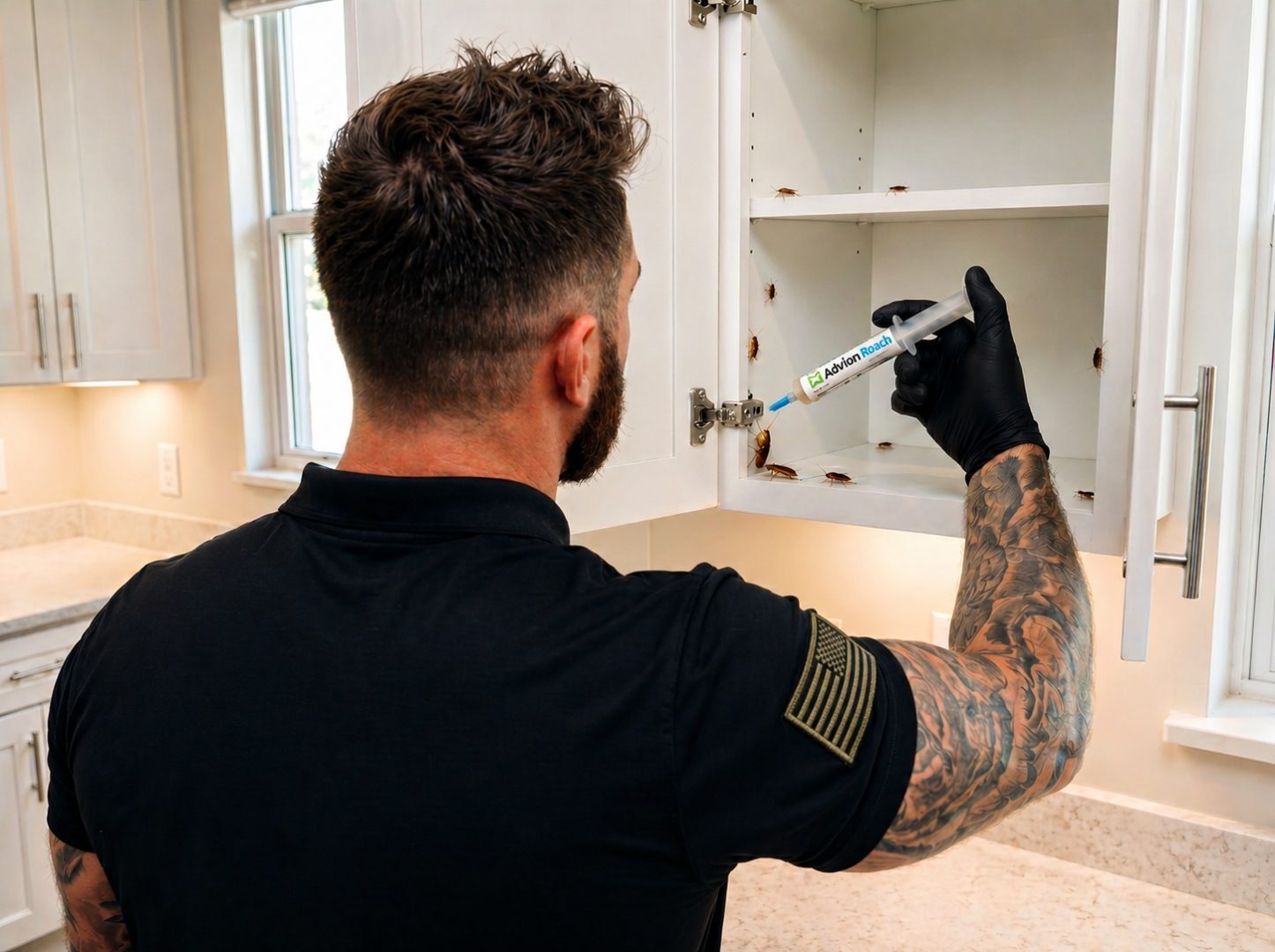
Why store-bought sprays fail: Repellent sprays cause colony fragmentation — roaches scatter to new harborage areas, making them harder to find and eliminate. Gel bait works by letting roaches carry the toxicant back to the nest, eliminating hidden populations. It's the difference between killing the roaches you see and eliminating the colony you don't.
Our protocol is designed to eliminate the whole colony, not just the ones you see.
Florida hosts multiple cockroach species, each requiring a tailored treatment approach. We identify exactly what you're dealing with before we treat.
Small at just ½ inch, light brown with two dark stripes behind the head. Found almost exclusively indoors — in kitchens, bathrooms, and behind appliances. Reproduces explosively: a single egg case hatches 30 to 40 nymphs, and the entire life cycle takes only 60 days. One female can produce hundreds of offspring in her lifetime. Requires an aggressive, multi-visit treatment protocol.
Florida's iconic "palmetto bug" — large at 1.5 to 2 inches, reddish-brown with a yellowish figure-eight pattern behind the head. They fly, especially in warm weather. Primarily an outdoor species living in trees, sewer systems, and mulch beds, entering homes through gaps around pipes, drains, and under doors — especially after rain. Perimeter treatment and exclusion work are key.
Florida's tropical climate hosts several additional species: Asian cockroaches look nearly identical to German roaches but are attracted to light and fly freely; smoky brown cockroaches (dark mahogany, 1.5 inches) live in attics and outdoor trees; and Australian cockroaches (reddish-brown with yellow markings) are common in tropical South Florida. All are treated with species-appropriate protocols.
A science-based, multi-step approach designed to eliminate the whole colony — not just the cockroaches you can see.
We begin with a thorough inspection — identifying the species present, locating harborage areas (where roaches hide and breed), mapping entry points, and assessing infestation severity. This is not optional; treatment without a proper inspection is guesswork. German roaches and palmetto bugs require completely different protocols.
Before any chemical application, we use commercial HEPA vacuuming to physically remove visible cockroaches, egg cases (oothecae), and debris from harborage areas. This immediately reduces the active population and removes egg cases that would otherwise hatch resistant nymphs. It also removes repellent chemical residues that would interfere with gel bait acceptance.
We deploy a combination of professional tools tailored to the infestation: gel bait placed in cracks and crevices where roaches travel; insect monitors (glue traps) to track population decline; crack-and-crevice spray for harborage areas; and IGR (insect growth regulators) that prevent nymphs from reaching reproductive maturity — breaking the reproductive cycle at its source.
German roach elimination requires patience. Treatments are repeated every 7 to 10 days to catch newly hatched nymphs before they reach reproductive maturity. Most infestations are controlled within 4 to 6 weeks; severe cases may take 2 to 3 months. After elimination, we transition to an ongoing monthly or bi-monthly maintenance plan to intercept any re-introduction before it becomes a new infestation.
Cockroaches are nocturnal and expert hiders. By the time you see one, there are likely hundreds more you don't. Watch for these warning signs.
Most pest control companies spray a repellent product and leave. We take a fundamentally different approach — one built around eliminating the colony, not just the cockroaches you can see right now.
Every service starts with a proper inspection. We identify the species, map harborage areas, and locate entry points before applying a single product. Treatment without inspection is guesswork — guesswork doesn't eliminate cockroach colonies.
We use commercial-grade gel baits, insect growth regulators, and HEPA vacuuming equipment that are not available to the public. These are the tools that actually eliminate German roach colonies — the same protocol used in the most severe commercial infestations.
German roach elimination requires multiple visits. We schedule follow-up treatments every 7 to 10 days and monitor population decline using glue traps. We don't consider the job finished until your monitors show a clear, sustained decline. No hidden fees, no surprises.
Gel bait — our primary German roach tool — is applied in tiny amounts inside enclosed spaces where children and pets cannot reach. We use only EPA-approved products and will walk you through any preparation needed before your service. No need to vacate for extended periods.
Tier 1 Pest Solutions is a licensed, insured Florida pest control company — not a national franchise. FL License No. JB321482 | JE132152. Our technicians are trained on Florida-specific pest biology, including the roach species unique to South Florida's tropical climate.
After elimination, we offer ongoing monthly and bi-monthly maintenance plans with unlimited free touch-ups between visits. In Florida's climate — and especially in multi-family properties — prevention is the only long-term solution. We make it affordable and completely hassle-free.
Answers to the most common questions about our cockroach extermination service in South Florida.
Fill out the form and we'll reach out to schedule your free cockroach inspection and quote. The sooner treatment begins, the easier — and less expensive — it is to eliminate. Or call us directly with questions.
We serve homeowners and businesses throughout the South Florida region. Not sure if we cover your area? Give us a call.
...and all of South Florida. Not sure if we cover your area? Give us a call at (813) 548-6341 — we're always expanding our service territory and happy to help.