Florida's tile roofs, royal palms, and year-round warmth make it the ideal environment for roof rats — the dominant rodent invader across Tampa Bay and South Florida. Unlike northern states, there's no cold season to slow breeding. Tier 1 Pest Solutions delivers complete rodent elimination built specifically for Florida homes, with permanent exclusion sealing so they don't come back.
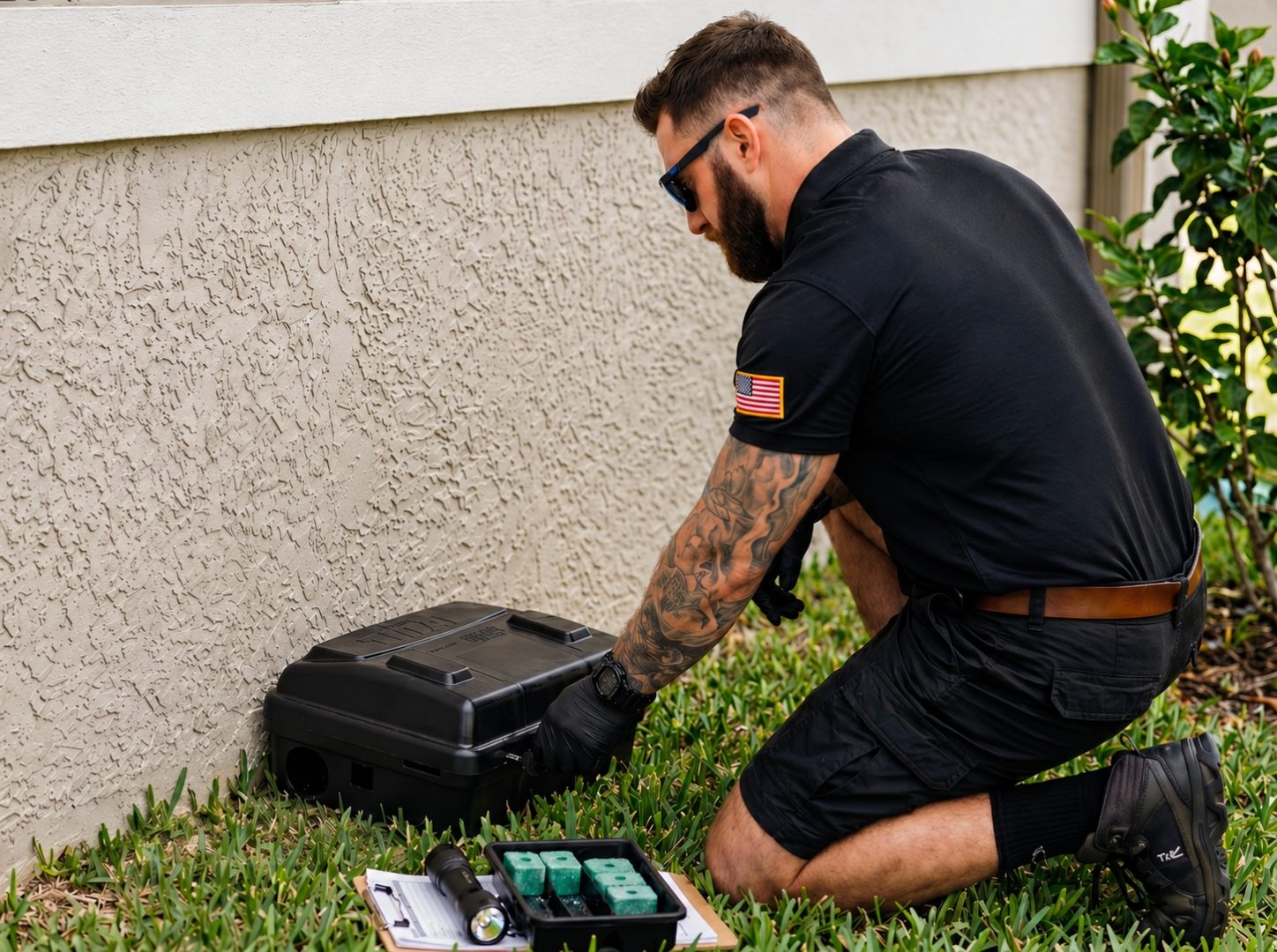
The roof rat (Rattus rattus) — also called the black rat or palm rat — vastly outnumbers Norway rats throughout South and Central Florida. Built for canopy life, roof rats scale royal palms, navigate power lines, and slip into homes through attic vents, soffit gaps, and damaged tile. Florida's tile roofs, which are standard across Tampa, Naples, Sarasota, and Miami, create natural entry channels under each tile course that Norway rats could never exploit. If you're hearing nighttime scratching overhead, it's almost certainly a roof rat.
Florida's mild winters allow roof rats to breed every month of the year, producing 4 to 6 litters annually with 5 to 12 pups per litter. A single breeding pair can yield 35 to 60 offspring under Florida's conditions — compared to far lower numbers in colder states where winter disrupts reproductive cycles. Compounding the pressure, suburban development has reduced populations of rat snakes and other natural predators, removing an ecological check that once helped keep rodent numbers in balance. The result: Florida homes face relentless, year-round rodent pressure that simply doesn't exist in northern markets.
Common Florida landscaping and architecture create an almost ideal rodent environment. Royal palms, oaks, and ficus trees provide climbing routes directly to rooflines. Backyard fruit trees — mango, citrus, and avocado — supply food year-round when wild food sources thin out elsewhere. Pool screen enclosures and lanai roofs offer sheltered, low-traffic nesting areas. Add pet food left outdoors and the accumulated leaf litter from palmetto and banana trees, and most Florida yards are actively inviting rodents closer to the structure every day.
Tampa, St. Petersburg, Clearwater, Wesley Chapel, Brandon, Lakeland, Sarasota, Bradenton, Naples, Fort Myers, Cape Coral, Miami, Fort Lauderdale, West Palm Beach, Boca Raton, Wellington
Unlike most of the country, Florida offers rodents something rare: a year-round warm climate with no seasonal die-off. There's no winter to thin populations, no freeze to drive rodents out — just continuous breeding, constant pressure, and millions of homes providing exactly the food, water, and shelter they need.
Roof rats enter through rooflines and soffits, contaminating insulation with droppings, urine, and nesting material — often undetected for months until damage is severe.
Rodents constantly gnaw — including on electrical wiring inside walls and attics. Chewed wires are one of the leading hidden causes of house fires across Florida.
A pair of mice can produce 60+ offspring in a year. What starts as one or two rodents becomes a full-scale infestation in weeks without intervention.
Each species requires a different approach — our technicians are trained to identify and target all three common Florida rodent invaders.
The most common rodent in Florida homes. Sleek, agile climbers that travel along tree branches, power lines, and fences to access your roofline. They nest primarily in attics, dropping insulation and leaving droppings in areas you may never see.
Larger and more aggressive than roof rats, Norway rats stay at ground level. They burrow near foundations, concrete slabs, and under landscaping. Common near waterways, dumpsters, and in older neighborhoods with established vegetation.
Small but incredibly prolific, house mice squeeze through any opening the size of a dime. They nest in wall voids, behind appliances, and inside cabinets. Their rapid reproduction rate means a small problem becomes a large infestation in just weeks.
A systematic four-step approach built around permanent results — not just temporary knockdown.
We identify the rodent species present, map all entry points, assess damage to wiring and insulation, and inspect attic, crawlspace, garage, and exterior perimeter. No guessing — only evidence-based findings.
We seal every identified entry point — gaps around pipes, soffit vents, roof returns, fascia damage, foundation cracks — using chew-proof materials including hardware cloth, copper mesh, and concrete. This step is what makes our solutions permanent.
Strategic placement of tamper-resistant bait stations at exterior perimeter and snap traps in attic and void spaces. We target active runways and feeding zones for maximum efficiency and rapid population reduction.
Regular follow-up visits to rotate bait, check trap activity, verify exclusion integrity, and inspect for new entry points. Florida's constant pressure means monitoring is what keeps your home rodent-free long-term.
Rodents are nocturnal and secretive — most infestations go undetected until they've become serious. Know what to look for.
Rodents are not a nuisance you can wait out. Every day of inactivity means more damage, more risk, and a larger population to eliminate.
Rodents must constantly gnaw to control tooth growth. Electrical wiring in walls and attics is a common target — and chewed wires are one of the leading hidden causes of house fires in Florida. You may never see the damage until it's too late.
Roof rats nesting in your attic saturate insulation with urine and feces over time, rendering it biologically contaminated and thermally ineffective. Full attic insulation removal and replacement can cost $3,000–$8,000+.
Florida rodents carry hantavirus (spread through droppings and urine aerosols), leptospirosis (transmitted through contaminated water and surfaces), and salmonella. These diseases pose real health risks to your family and pets.
A single pair of mice can produce 60+ offspring in one year. Two roof rats in your attic in January can become 20–30 by spring. Small problems compound quickly — early intervention is exponentially less costly than treating an established infestation.
Hearing noises in your attic? Finding droppings? Don't wait — the problem only grows.
Schedule Your Free InspectionEverything you need to know about our rodent control service.
Fill out the form and we'll reach out to schedule your free inspection. We'll identify every entry point, every sign of activity, and give you a clear plan to eliminate the problem permanently. Or call us now to speak directly with a technician.
We provide professional rodent control services throughout the South Florida region.
...and all of South Florida. Not sure if we cover your area? Call us at (813) 548-6341 — we're always expanding.