Palm Beach County's Fire Ant Specialists

Fire Ant Control in West Palm Beach, FL

Palm Beach County properties — from coastal homes to inland estates and properties with horses or other livestock — face year-round fire ant pressure. Fire ant control is included in every Tier 1 pest control plan at no extra charge — across West Palm Beach, Palm Beach Gardens, Jupiter, Boca Raton, and surrounding communities. We use the research-backed Two-Step Method to eliminate colonies yard-wide, not just the mounds you can see. See our full Palm Beach pest control plans.
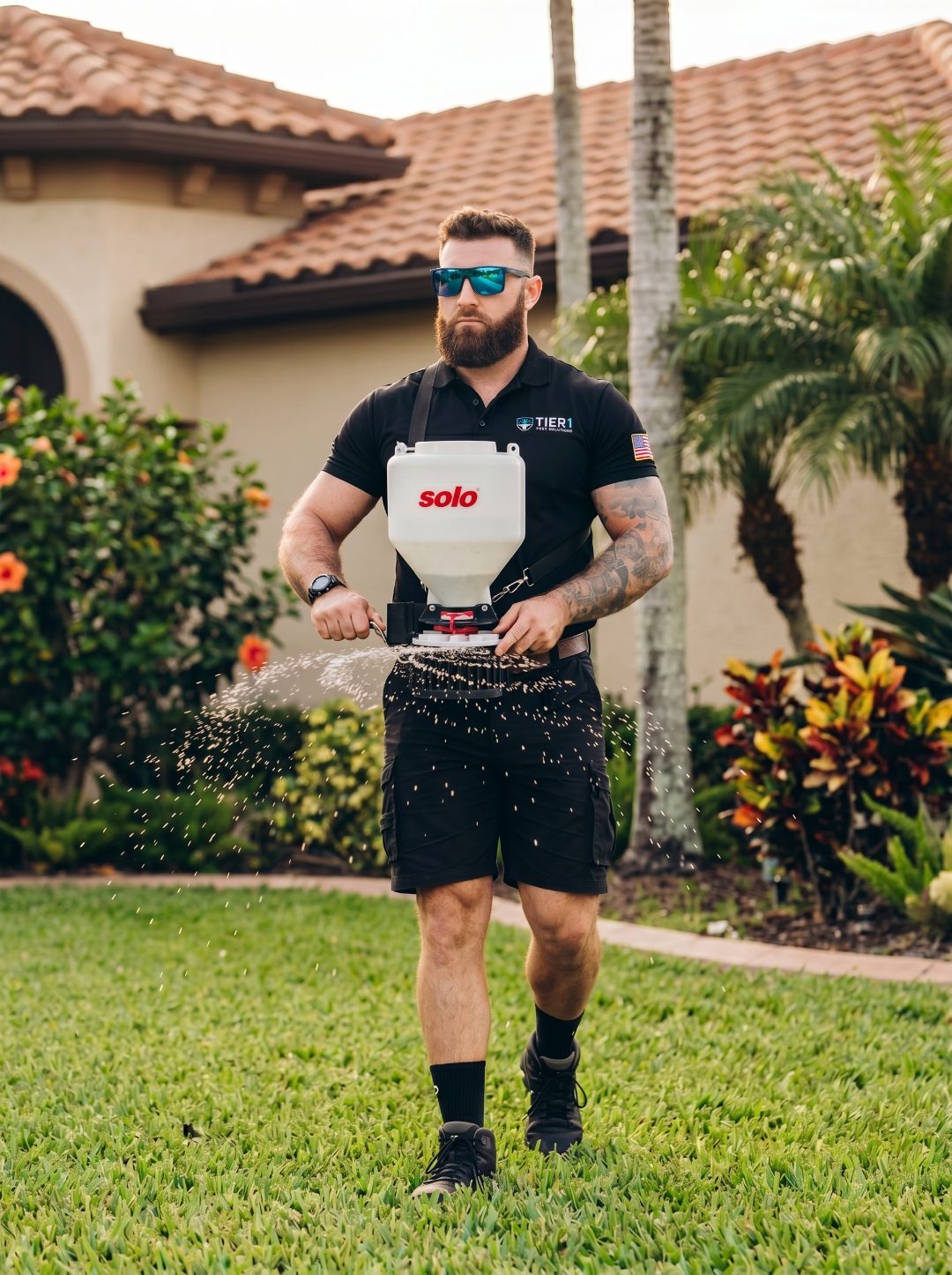
Tier 1 Pest Solutions technician broadcasting fire ant bait across a West Palm Beach lawn
EPA-Approved ProductsProfessional-Grade Formulations
Pet & Kid SafeReturn to Lawn Within 2 Hours
Two-Step MethodUniversity Research-Backed
Pet & Livestock SafeApplied at Label Rates
No Extra Charge. Ever.

Fire Ant Control is Built Into Every Tier 1 Pest Control Plan

Fire ant treatment isn't an add-on or a separate service call. When we treat your West Palm Beach or Palm Beach County property, we treat your yard for fire ants as part of every visit — using the research-backed Two-Step Method at no extra cost. Monthly or bi-monthly — fire ants are covered. See Palm Beach pest control plans.

View Pest Control Plans (813) 548-6341

Why Palm Beach County Has Year-Round Fire Ant Pressure

The red imported fire ant (Solenopsis invicta) was accidentally introduced to Alabama from South America in the 1930s and has since spread across the southeastern United States. Palm Beach County — together with Broward and Miami-Dade — forms the heart of South Florida's most severe fire ant zone. Pest professionals recognize this three-county area as having some of the densest fire ant populations in the country, driven by year-round warmth, abundant rainfall, sandy coastal soil, and the relentless irrigation cycles that keep Palm Beach County's estate lawns and turf in play all year long. For Palm Beach area homeowners, understanding why helps explain why most DIY treatments fail and why the right approach makes such a decisive difference.

  • No Winter Kill-Off — Year-Round Activity In most of the US, cold winters kill a significant portion of fire ant colonies and provide homeowners with a seasonal reprieve. Palm Beach County's soil temperatures never drop below the 60°F threshold that slows fire ant activity — colonies breed, forage, and expand 365 days a year with no natural die-off period. The threat never pauses.
  • Sandy Coastal Soil — Ideal Nesting Conditions Palm Beach County's sandy, well-draining coastal soils are exceptionally easy for fire ants to excavate and tunnel through. Colony expansion is faster here than in heavier clay soils further north. Sandy soil also dries quickly between rain events, encouraging ants to build mounds near irrigation heads and water sources — exactly where estate lawns are densest.
  • Heavy Irrigation Accelerates Spread Palm Beach County's estate properties, private golf courses, and other large maintained landscapes operate intensive irrigation systems that keep the soil moist year-round — precisely the conditions fire ants prefer. Irrigation edges and valve boxes are common hotspots for mound establishment, and the constant moisture accelerates colony growth and budding to new satellite locations.
  • Landscape Disturbance Re-Introduces Colonies Constantly Estate properties and gated communities in Palm Beach County rely on weekly landscape maintenance crews — mowing, edging, trimming, mulching. Every landscape disturbance event disrupts existing mounds, triggering colony relocation and satellite mound creation. Even after successful treatment, newly disturbed soil is quickly recolonized from neighboring untreated properties. Consistent, plan-based treatment is the only sustainable answer.
  • One of the Biggest Pest Problems in South Florida Fire ants have been called one of the biggest problems facing homeowners in South Florida. Palm Beach County's combination of large-lot properties, abundant open sunny lawn space, and tropical growing conditions creates near-ideal habitat. Denser coastal soils north of the county provide some natural resistance; Palm Beach's sandy, irrigated landscape offers almost none.
365 Days per year of active fire ant pressure in Palm Beach County
$0 Extra charge for fire ant control — included in every plan
3 County South Florida fire ant triangle — PBC, Broward, Miami-Dade
>90% Colony control achieved with the Two-Step Method per Texas A&M research
Palm Beach County Communities

We serve all of Palm Beach County — from coastal communities like Palm Beach Island, Singer Island, Manalapan, and Gulf Stream, to inland communities such as Wellington, Loxahatchee, Boynton Beach, Lake Worth, and Greenacres.

Full Palm Beach service area

Fire Ants Are a Real Safety Hazard in Palm Beach County

In South Florida, fire ant encounters aren't rare events — they're a near-daily risk on properties with active infestations. Palm Beach County's large pet populations, estate gardens, large turf properties, and properties with livestock create constant opportunities for dangerous human and animal contact with mounds.

What Makes Fire Ants in Palm Beach County Different

  • Estate lawns and manicured grounds — Weekly mowing and edging continually disturb mounds. Workers flood landscaping crews and homeowners who get too close during routine yard work.
  • Children and grandchildren on estate grounds — Properties with large lawns, play areas, and open land give children more exposure. A child can step on an unmarked mound in seconds.
  • Dogs and cats on large properties — Palm Beach County's affluent communities include many multi-pet households and private dog runs. Pets are highly susceptible to fire ant swarming attacks.
  • Horses and other livestock — Foals and recumbent animals are particularly vulnerable to fire ant swarming — a newborn foal in a paddock with an active mound is at serious risk. Mound disturbance during turnout or pasture maintenance can trigger mass stinging events that injure animals. This is a recognized concern across the southeastern US wherever fire ants and livestock share pasture.
  • Private golf courses and large turf areas — Mounds in fairways and other open turf are invisible hazards to players, staff, and spectators. Sand-based golf courses and large maintained turf areas are prime fire ant habitat.
  • Anaphylaxis risk — Approximately 1–2% of the population is hypersensitive to fire ant venom. Multiple simultaneous stings — which occur when any mound is disturbed — increase anaphylaxis risk significantly.
⚠ Anaphylaxis Warning

Know the Signs of a Severe Reaction

Most fire ant stings cause localized pain and a white pustule within 24 hours. But severe reactions require emergency care immediately.

  • Throat tightening or difficulty breathing
  • Chest pain, dizziness, or rapid heartbeat
  • Hives spreading beyond the sting sites
  • Nausea, vomiting, or loss of consciousness

If these symptoms occur, call 911 immediately and use an EpiPen if available. Children, the elderly, and those with known insect allergies are at highest risk.

Eliminate the Risk — Call Now

Recognizing Fire Ant Mounds on Palm Beach County Properties

Palm Beach County's sandy soils and irrigated lawns create distinctive fire ant mound patterns that differ from what you might see in northern Florida or the rest of the US. Here's what to look for on estate lawns and maintained turf.

Dome-Shaped Sandy Mounds — Flatter in Sandy Soil

Classic fire ant mounds in Palm Beach County appear as irregular, dome-shaped soil mounds ranging from 2 inches to 18 inches tall. In Sandy coastal soil, mounds tend to be lower-profile and wider than in clay soils — easy to mistake for natural soil variation or turf irregularities. No central hole is visible at the top — fire ants enter through tunnels at the base or sides of the mound.

Found in Open, Sunny Lawn and Paddock Areas

Fire ants prefer open, sunny areas — lawns, sports fields, garden beds, along driveways and walkways, near irrigation heads, and along fence lines. They avoid shade and dense ground cover. In Palm Beach County, St. Augustine grass lawns and Bermuda grass turf are prime real estate for fire ant colonies. Expect mounds near irrigation valve boxes and AC condenser units as well.

Violent Eruption When Disturbed

The most unmistakable sign of a fire ant mound: any disturbance — from stepping, mowing, horse hoof traffic, or even a vibration — triggers an immediate eruption of hundreds of aggressive worker ants that swarm upward within seconds. This defensive behavior is unique to fire ants and far more intense than any other Florida ant species. On large turf properties, mowing or dragging can disturb dozens of mounds simultaneously.

More Mounds Visible After Rain

West Palm Beach homeowners often call us right after heavy summer rain saying "the mounds appeared overnight." Rain floods the underground tunnel network and forces ants to move upward, creating new mound openings at higher elevations. Palm Beach County's intense summer storm season — June through September — triggers this regularly. Post-rain is the best time to assess the true extent of a fire ant infestation on your property.

Near Electrical Equipment and Irrigation Controls

Fire ants are attracted to electrical fields and warmth. On Palm Beach County properties of all types, colonies commonly establish beneath or inside HVAC condensers, irrigation control boxes, electric gate boxes, and pool pump equipment. These "hidden" infestations can cause equipment failures and are easily missed during a visual lawn inspection. On properties with outbuildings or animal facilities, electrical panels and automatic waterers are also common harborage sites.

Multiple Satellite Mounds Across the Property

A single fire ant colony in Palm Beach County's sandy soil can maintain multiple mound entrances — satellite mounds — spread dozens to hundreds of feet apart from the main colony. Treating one visible mound while satellite mounds go untreated means re-infestation within weeks. Estate-sized properties with ½ acre or more of open lawn typically harbor far more colonies than are visible at any given time. Yard-wide bait broadcast is the only way to reach every colony simultaneously.

The Two-Step Method — How It Works

The Texas A&M Imported Fire Ant Research and Management Project developed and recommends the Two-Step Method as the most effective approach to fire ant control — adopted by university extension programs across the southern United States. It's the same method we use on every property in our service area — residential lawns, estate properties, and properties with horses or other livestock.
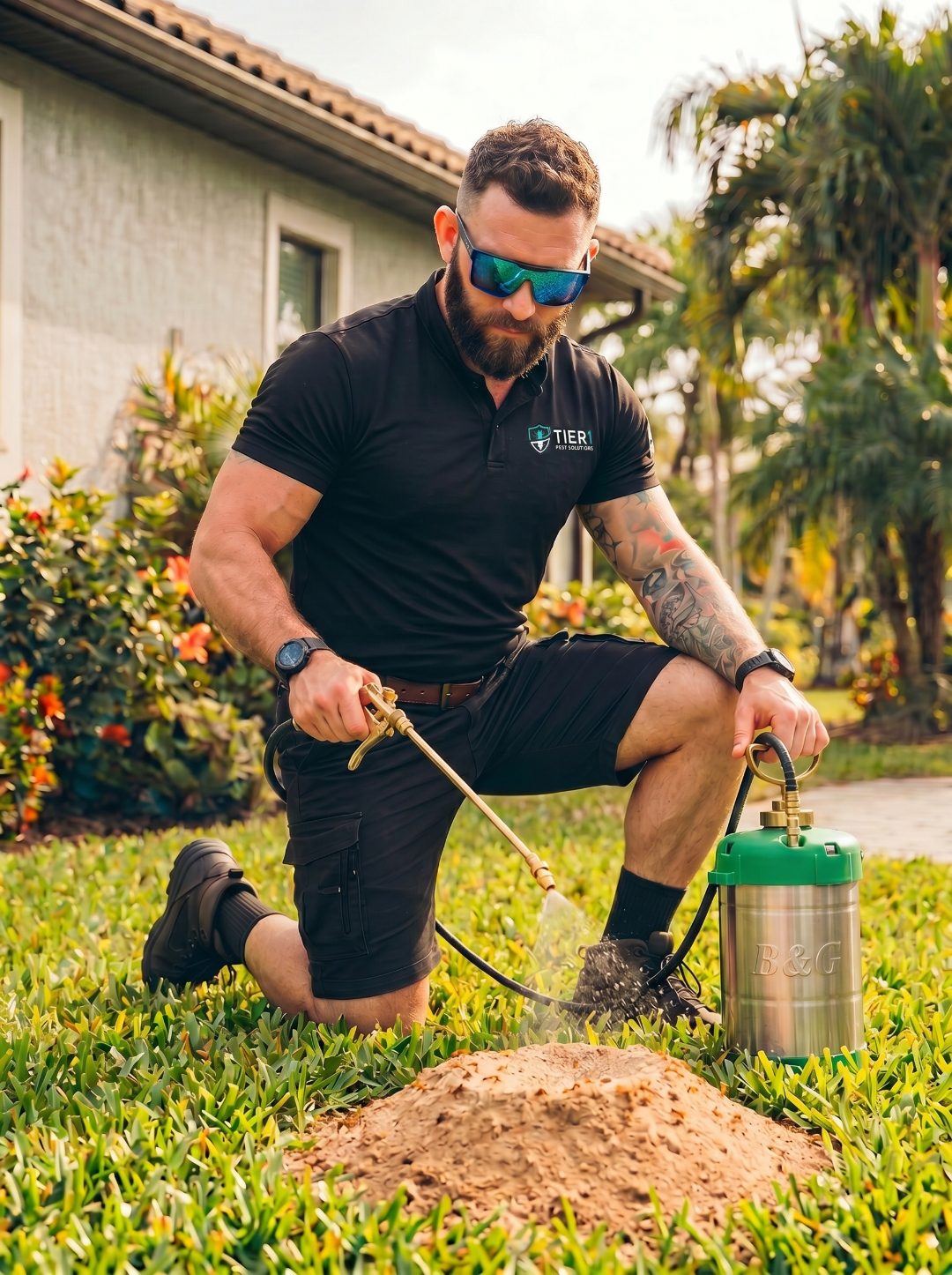
Tier 1 Pest Solutions technician treating an active fire ant mound in a West Palm Beach FL yard with B&G professional sprayer
01

Broadcast Bait — Yard-Wide Coverage

Worker ants are foragers — they travel up to 100 feet from their mound to gather food. We broadcast EPA-approved IGR-coated granular bait across your entire yard using a calibrated Solo professional spreader. Workers pick up the bait during normal foraging activity and carry it back to the colony, where it's distributed to the brood and shared with the queen. The IGR (insect growth regulator) component prevents the queen from producing viable eggs, collapsing the colony's ability to reproduce.

This step is critical because it catches every colony on your property — including satellite mounds and hidden colonies that haven't broken the surface yet. For large Palm Beach County properties — including those with horses or other livestock — yard-wide broadcast is the only practical way to achieve comprehensive coverage.

02

Direct Mound Treatment — Fast Knockdown

For visible, active mounds — especially those in high-traffic areas, near play equipment, along fence lines, adjacent to your home's foundation, or near building perimeters — we apply a professional liquid drench directly to the mound using a B&G stainless-steel sprayer. The liquid product penetrates deeply into the tunnel network to reach and kill the colony quickly, typically within 24 to 72 hours for the treated mound. This provides fast relief in areas where fire ants pose the most immediate risk while the broadcast bait works across the rest of the property over 1 to 4 weeks.

?

Why DIY Single-Step Approaches Fail

Single-step treatment — missing the queen

Contact sprays kill surface workers but the queen is underground, often several feet deep. She'll rebuild the colony within weeks. Boiling water kills only ~60% of colonies and kills the grass around the mound. Store-bought granules applied only to visible mounds miss satellite mounds entirely — and on Palm Beach County estate properties, there are always satellite mounds you can't see.

According to the Texas A&M fire ant research program, the Two-Step Method is the only approach proven to consistently achieve >90% control of fire ant colonies across a treated area. The combination of yard-wide bait coverage and targeted mound treatment for visible problem areas is what makes the difference between temporary relief and sustained control. See also our Tampa fire ant control page for more on how this method performs across all of South Florida.

How We Handle Fire Ants During Your Pest Control Service

Fire ant control isn't a separate appointment. Here's exactly what your Tier 1 technician does for fire ants as part of every scheduled general pest control visit — included in your plan, no extra charge, covering West Palm Beach to Boca Raton.

1

Property Walk — Included at Every Scheduled Visit

Every Tier 1 technician walks the full property during each scheduled service visit — not just the interior and perimeter. They count visible mounds, assess fire ant activity level, and flag hot zones: children's play areas, pet runs, walkways, AC condenser units, garden beds, irrigation heads, pool pump areas, and the foundation perimeter. On properties with horses or other livestock, the walk includes building perimeters and fence lines. If fire ant activity has increased since the last visit, they adjust treatment on the spot. This inspection is part of your Palm Beach pest control plan — no separate scheduling, no extra cost.

2

Yard-Wide Bait Broadcast When Fire Ant Activity Is Present

When fire ant activity warrants it, your technician broadcasts EPA-approved IGR-coated granular bait across the entire lawn using a calibrated Solo handheld spreader. Worker ants forage up to 100 feet from their mound, so yard-wide broadcast ensures every colony has access to the bait — including hidden underground mounds you haven't spotted yet. Workers carry the bait back and share it with the queen, collapsing colonies from the inside out over 1 to 4 weeks. This step is performed as part of your regular pest control visit, covered by your plan. On properties with horses or other livestock, bait is broadcast around buildings and along fence lines — not on active grazing areas.

3

Direct Mound Drench on Active Problem Mounds

Active mounds in high-risk locations — near play equipment, along walkways, adjacent to the foundation, in pet runs, or near building entrances — receive a direct liquid drench using professional B&G equipment. The liquid penetrates the tunnel network for fast knockdown within 24 to 72 hours, addressing the immediate safety risk while the broadcast bait works across the rest of the yard. Your technician applies this each visit as warranted — it's part of your pest control plan, not an upcharge.

4

Foundation Perimeter Treatment — Standard on Every Visit

Every Tier 1 pest control visit includes a residual perimeter treatment around the home's exterior foundation — this is standard, not a fire-ant-specific step. Fire ants routinely move indoors through foundation cracks, utility penetrations, and expansion joints, especially during Palm Beach County's hottest months and heavy summer rain events when colonies relocate upward. The perimeter treatment kills workers attempting to enter the structure and discourages new colony establishment directly adjacent to your home. Covered by your plan, every visit.

5

Activity Notes for Next Visit

After treating, your technician records fire ant activity levels, mound locations, and treatment observations for your property. These notes are referenced at the next visit so your service builds on itself — your technician knows which mounds collapsed, where new activity has appeared, and whether to prioritize bait broadcast or mound drench at the next service. Each visit is informed by the last, which is why consistent plan coverage is more effective than one-time treatments — particularly on large Palm Beach County estate properties where conditions change between services.

6

Free Service Call if Mounds Flare Up Between Visits

Palm Beach County's year-round fire ant pressure means new mounds can appear between your scheduled pest control visits — especially during peak summer months and following major rain events. If that happens, call us. As a Tier 1 pest control plan customer, we return and treat at no additional charge. No service call fee, no negotiation. Fire ant re-treatments between visits are covered the same way any pest callback is covered — it's part of what your plan includes. See Palm Beach plan details.

Safe for Pets, Kids & Horses — No Compromise

We know that concerns about chemical treatments are real — especially when children, pets, or livestock share the same property we're treating. That's why we're explicit about what we use, how we apply it, and what it means for your family and animals.

The bait and drench products in our Two-Step protocol are EPA-approved formulations applied at label rates. Every product we use has been registered for residential and commercial property use by the EPA — meaning they've been reviewed for safety to people, pets, horses, and the environment when used as directed. We apply them as directed.

  • 2-hour re-entry window: Families, pets, and horses can return to treated areas within approximately 2 hours of treatment, once product has dried. We confirm this before leaving your property.
  • Granular bait mimics food: The broadcast bait is a granular product that worker ants forage and carry underground — it's not a contact spray applied across open turf. Once applied to the grass, it breaks down within days and doesn't persist as a surface residue.
  • Safe around horses and livestock: On properties with animals, we apply product at label rates around buildings and along fence lines — not on active grazing areas — and brief the property owner on re-entry timing before leaving.
  • No odor, no visible residue: Our products are designed for residential use and leave no staining, strong odors, or visible film on lawn surfaces after drying.
  • Treated zone marking: We clearly mark treated areas before leaving and brief every property owner on any precautions specific to their treatment before we go.
  • FDACS-licensed applicators: Every Tier 1 technician holds active Florida Department of Agriculture and Consumer Services (FDACS) licensure. We're bonded and insured and carry licenses FL JB321482 and JE132152.
View Pest Control Plans (813) 548-6341
Fire Ant Control — Included in Every Plan

No Separate Charge. Ever.

Fire ant treatment is built into every Tier 1 general pest control plan. Here's what's covered for fire ants on every scheduled visit — no add-ons, no extras.

  • Property walk and mound assessment
  • IGR bait broadcast when activity is present
  • Direct mound drench on active problem mounds
  • Foundation perimeter treatment (standard every visit)
  • Free callback if mounds flare up between visits
  • Safe for pets, kids, and livestock when used as directed
  • No separate fire ant charge — ever
View Pest Control Plans

Service Available for Properties with Horses & Other Livestock

Properties with horses, ponies, and other livestock face fire ant risks that don't apply to typical residential lawns. We service these properties throughout our Palm Beach County coverage area and apply products thoughtfully around buildings and along fence lines — not on active grazing areas — to keep animals safe while addressing the colony pressure.

Foals are especially vulnerable. A newborn foal lying in a paddock with an active mound can be swarmed before it can stand and flee — fire ant injuries to foals are a recognized concern across the southeastern US wherever fire ants and livestock share pasture. Older horses, ponies, and donkeys disturb mounds during turnout, paddock dragging, and normal grazing, triggering stinging events that can cause pain and injury. Properties with horses or other livestock are typically served through our commercial pest control plans, which include documented treatment records and scheduled service.

  • Building perimeters covered: Fire ants frequently establish mounds at building foundations, doorways, and storage areas. We treat building perimeters as part of routine service on properties with livestock.
  • Paddock fence lines and gate entries: Fire ant mounds cluster along fence lines and gate entries — areas horses pass through repeatedly. We broadcast bait along fence corridors and treat active mounds at all gate entries.
  • Riding ring and arena perimeters: Sandy arena footing creates ideal fire ant nesting habitat adjacent to ring edges. We treat ring perimeters and any mounds visible within the ring boundary.
  • Safe for horses — label-rate application only: EPA-approved granular bait is applied at label rates away from active grazing areas. Standard 2-hour re-entry applies. We brief every property manager on animal re-entry timing before leaving.
  • Treatment documentation available: For commercial properties that require documented pest treatment records, we provide service documentation for your files. See commercial pest control.
Properties with Livestock

Equestrian Fire Ant Coverage

  • Barn perimeter treatment
  • Paddock edge and fence line broadcast
  • Riding ring and arena perimeter
  • Active mound drench at gate entries
  • Horse-safe re-entry (2-hour dry-down)
  • EPA-approved products at label rates only
  • Documented treatment records on request
  • FDACS-licensed applicators (FL JB321482, JE132152)

Mosquito misting and fogging are also available. See Palm Beach misting systems and Palm Beach fogging for outdoor mosquito coverage on residential and commercial properties.

Palm Beach County Communities We Serve

We provide fire ant control across Palm Beach County — from coastal communities to inland neighborhoods, including properties with horses or other livestock. See all Palm Beach pest control services.

West Palm Beach
Palm Beach Island
Palm Beach Gardens
Jupiter
Boca Raton
Delray Beach
Boynton Beach
Lake Worth
Royal Palm Beach
Greenacres
Singer Island
North Palm Beach
Manalapan
Gulf Stream
Highland Beach
Tequesta
Lantana
Wellington
Loxahatchee
The Acreage

  Not on the list? We serve all of Palm Beach County. Call (813) 548-6341 to confirm coverage. See Palm Beach pest control for full area services.

Same-Week Treatment Available

Got Fire Ants in Your West Palm Beach Lawn?

Don't let fire ants put your family, pets, or horses at risk another week. Call us today for a free inspection and same-week service start. 50% off your first pest control visit — no fine print. Fire ant control included in every plan at no extra charge. See Palm Beach plans.

(813) 548-6341 Get Free Inspection
Included
In Every Pest Control Plan
No separate fire ant charge. Ever.

What Sets Us Apart in Palm Beach County

We're a FDACS-licensed pest control operation that treats fire ant control as a science — not a one-size-fits-all service. Here's why Palm Beach County property owners choose Tier 1 over the national chains. See our full Palm Beach pest control page for service details.

FDACS-Licensed & South Florida-Ready

Our technicians hold active Florida Department of Agriculture and Consumer Services licenses (FL JB321482, JE132152) and understand the specific conditions that drive fire ant pressure in Palm Beach County — sandy coastal soils, intensive irrigation cycles, large-lot estate properties, and the considerations that come with treating properties that have horses or other livestock. This is a local operation serving local homeowners and property managers, not a national call center.

University Research-Backed Method

We use the Two-Step Method recommended by Texas A&M's fire ant research program and extension services across the South. We don't invent a proprietary approach — we use the method that peer-reviewed research consistently shows achieves >90% colony control. The science works. We apply it correctly on every property in our service area.

Equestrian Property Expertise

On properties with horses or other livestock, our technicians apply product at label rates around buildings and along fence lines — not on active grazing areas — with treatment zones planned around animal traffic patterns and dry-down timing before re-entry. For commercial properties, including those with livestock, see our commercial pest control plans.

Free Re-Treatment Guarantee

If fire ant mounds return after treatment, we come back and re-treat at no extra charge. We don't charge a service call fee, and we don't make you negotiate. Our follow-up policy is part of every treatment — not a premium add-on. We win when your yard stays fire ant-free, not when you pay for repeat visits. Palm Beach County's year-round fire ant pressure means callbacks are part of the service reality — we plan for them so you don't have to pay extra for them.

Fire Ant Control Comes With Every Pest Control Plan

There's no separate fire ant service. Choose a general pest control plan that fits your schedule and property — fire ant control is built in from day one. Palm Beach County plans available.

Monthly
Most Active
Best for heavy fire ant pressure
  • Fire ant treatment every visit — no extra charge
  • Yard bait broadcast + active mound drench
  • Interior, perimeter, and yard treatment included
  • Free callbacks for any pest between visits
See Monthly Plan
Commercial / HOA
Flexible
For maintained estate properties
  • Fire ant treatment included at every visit
  • Bait broadcast + mound assessment each service
  • Free callback visits if fire ants return
  • Also covers roaches, spiders, ants, and more
  • For commercial options, call us
View All Plans

Fire ants are one of many pests covered. Our general pest control plans address interior pests, perimeter bugs, and yard pests — including fire ants, fleas, ticks, and lawn insects — all in one visit. Palm Beach County properties also benefit from mosquito misting systems and mosquito fogging to address the outdoor pest pressure that comes with South Florida's tropical environment. For commercial properties and HOA common areas, we provide documented treatment records suitable for property files.

Real Google Reviews

Frequently Asked Questions

Everything West Palm Beach and Palm Beach County property owners ask us about fire ant control, treatment safety, and what to expect.

With the Two-Step Method, most homeowners see significant reduction in fire ant activity within 1 to 2 weeks after treatment. The bait component works gradually — worker ants carry it back to the colony and share it with the queen, which is what kills the entire colony rather than just surface ants. Full colony elimination typically takes 2 to 4 weeks. Direct mound treatment with liquid drench works faster — often within 24 to 48 hours for the treated mound. We schedule a two-week follow-up inspection and re-treat any new mounds at no extra cost, so you're covered through the full elimination window.
Yes. The bait and drench products we use are EPA-approved and applied strictly at label rates. Families and pets can return to the treated lawn within approximately 2 hours of treatment, once product has dried. We clearly mark treated zones and brief every homeowner on any specific precautions before we leave. Our products are the same formulations used by licensed pest control professionals across Florida and are specifically approved for residential yard use. If you have a pet or family member with specific chemical sensitivities, let us know when you book and we'll walk through your options.
Yes. The EPA-approved granular bait and liquid drench products we use are applied at label rates and, when used as directed, are considered safe around horses and other livestock. On properties with animals, we apply product around buildings and along fence lines — not on active grazing areas. Animals can return to treated areas once product has dried, typically within about two hours; we confirm re-entry timing with the property owner before leaving. The Two-Step Method we use on residential lawns is the same approach we use on properties with livestock, with application zones planned around grazing patterns and animal traffic.
Palm Beach County sits at the heart of South Florida's most severe fire ant pressure zone — alongside Broward and Miami-Dade counties, it forms what pest professionals recognize as the South Florida fire ant triangle, where year-round warmth, high humidity, heavy seasonal rainfall, and sandy coastal soils create nearly ideal conditions for Solenopsis invicta colonies. Florida's soil temperatures in Palm Beach County never drop below the 60°F threshold that would slow fire ant activity, meaning colonies breed, forage, and expand 365 days a year with no natural winter die-off. Add the widespread use of irrigation on estate lawns and golf courses, and the constant landscape disturbance from maintenance crews, and you have a recipe for persistent, heavy fire ant pressure on virtually every Palm Beach County property.
The most common reason fire ants rebound after DIY treatment is that the queen survives. Contact sprays and liquid repellents applied only to the mound surface kill the workers you can see, but the queen and the bulk of the colony are deep underground — often several feet down. A living queen can rebuild a colony from scratch in a matter of weeks. The other issue is satellite mounds: a single fire ant colony can have multiple queens and multiple mound entrances spread across your yard. Treating one visible mound while satellite mounds go untreated means re-infestation is virtually guaranteed. The Two-Step Method addresses both problems by broadcasting bait that reaches queens across the entire yard — including mounds you can't see yet.
In West Palm Beach and Palm Beach County, fire ant treatment is effective year-round because Florida's climate never drops cold enough to slow fire ant activity significantly. Soil temperatures stay well above 60°F in every month, which means fire ants remain active, foraging, and reproducing throughout the year — there's no dormant period that provides natural relief. That said, fall and spring treatments are particularly effective because fire ant colonies are typically at peak foraging activity during mild temperatures, making bait uptake faster. If you're seeing mounds now, there's no reason to wait — same-week treatment is available.
Boiling water is one of the most commonly recommended DIY methods, but research shows it's only about 60% effective at killing the colony — and that's under ideal conditions with perfect application. The water must penetrate deep into the mound's tunnel system to reach the queen, which is difficult given fire ant tunnels can extend three to four feet underground. The hot water typically cools before reaching that depth, leaving the queen alive to rebuild. Boiling water also kills the grass and surrounding vegetation where it's applied, leaving dead patches in your lawn. It's a frustrating, labor-intensive method that works occasionally on small mounds but fails consistently on established colonies.
Fire ant stings are distinctive and recognizable. Unlike most insect bites that produce a flat red welt, fire ant stings form a raised, fluid-filled pustule — a small white blister — typically within 24 hours of the sting. This pustule formation is the signature characteristic of a fire ant sting and doesn't occur with most other ant species. The initial sting causes an immediate, intense burning pain (hence the name "fire ant") followed by itching as the pustule develops. Multiple stings are common because fire ants swarm when their mound is disturbed — a single disturbance can result in dozens or hundreds of stings in seconds. The pustules should be kept clean and not broken, as they can become secondarily infected.
Most people experience localized pain, burning, and pustule formation from fire ant stings — unpleasant but not life-threatening. However, approximately 1% to 2% of the population is hypersensitive to fire ant venom and can experience anaphylaxis, a severe systemic allergic reaction that is a medical emergency. Signs of anaphylaxis include throat tightening or swelling, difficulty breathing, chest pain, dizziness, rapid heartbeat, nausea, or widespread hives beyond the sting sites. If you or anyone in your household experiences these symptoms after fire ant stings, call 911 immediately and use an epinephrine auto-injector (EpiPen) if available. Children, the elderly, and those with known insect allergies are at elevated risk. The Asthma and Allergy Foundation of America provides detailed information on fire ant allergy risk and venom immunotherapy options at aafa.org.
Rainfall causes fire ant mounds to appear to multiply because water floods the ants' underground tunnel system. When rain saturates the soil, fire ants move upward and often create new mound openings at higher, drier ground to escape the flooding tunnels. Mounds that were too small to notice or hidden beneath grass become visible as the colony consolidates upward. Additionally, moist soil after rain is easier for ants to excavate, so new mound construction accelerates. The rain doesn't create new colonies — it reveals existing ones that were already present underground. This is often when West Palm Beach and Palm Beach County homeowners realize just how widespread their fire ant problem actually is.
Yes. We service properties with horses and other livestock anywhere in our Palm Beach County coverage area. We apply EPA-approved products at label rates around buildings, fence lines, and other property perimeters — not on active grazing areas — with the standard dry-down period before animals return. Horses, especially foals, can be vulnerable to fire ant stings when a mound is disturbed during turnout or routine maintenance. Fire ant treatment on properties with livestock is typically handled through our commercial pest control plans, which include treatment documentation for property records. Call (813) 548-6341 to discuss your property's needs.
Yes. Tier 1 Pest Solutions provides fire ant control for HOA common areas, community grounds, commercial properties, apartment complexes, equestrian facilities, and business campuses across Palm Beach County. Fire ant infestations in common areas create significant liability exposure — especially when children or pets are present. We can service common areas on a one-time or recurring bi-monthly basis and provide documentation of treatments for HOA records. For commercial fire ant control inquiries, visit our commercial pest control page or call us directly at (813) 548-6341.
Consumer-grade fire ant baits available at hardware stores use lower-concentration active ingredients and lack the IGR (insect growth regulator) formulations that professional products contain. IGR-based professional baits interrupt the queen's reproductive cycle, preventing her from producing viable eggs — which accelerates colony collapse even after the bait is no longer present. Beyond the product difference, the application method matters enormously: a uniform, calibrated broadcast across the entire yard using professional-grade equipment ensures even bait distribution so every foraging worker has access to it. Spot-treating visible mounds with a store-bought granule product is a common mistake — it misses the mounds you can't see yet and the satellite mounds already present in your yard.
The Two-Step Method was developed by the Texas A&M Imported Fire Ant Research and Management Project and is recommended by university extension programs across the South as the most effective approach to fire ant control. Step 1 is a yard-wide broadcast of granular bait — workers carry it back to the colony and share it with the queen, killing the colony from the inside out. This step reaches every colony in your yard, including mounds you haven't spotted yet. Step 2 is direct treatment of visible, active mounds with a liquid drench to knock down established colonies quickly. The combination of broadcast bait for complete yard coverage and targeted mound treatment for fast results is why this method consistently outperforms single-step DIY approaches.
No. Fire ant control is included in every Tier 1 general pest control plan at no additional cost. There is no fire ant add-on, no separate fire ant service call, and no per-visit upcharge when your technician treats mounds. When we visit your property for your scheduled pest control service, fire ant inspection, bait broadcast, and mound treatment are part of what happens — covered by your plan. If fire ant activity flares up between scheduled visits, we return at no charge. See our general pest control plans or Palm Beach pest control plans for details on what's included.
We don't offer fire ant treatment as a standalone one-time service — fire ant control is built into all of our general pest control plans. The reason is simple: fire ants in Palm Beach County are a year-round problem that requires consistent treatment across visits, not a one-time fix. Bundling fire ant control with a full pest control plan also gives you broader protection against roaches, spiders, indoor ants, and other common South Florida pests — all covered under the same plan, same visit. If you're dealing specifically with fire ants and want to get started, a Palm Beach pest control plan is the right entry point.

Ready for a Fire Ant-Free Lawn?

Fill out the form and we'll reach out to schedule your free inspection and get you started with same-week service. Fire ant control is included in every plan at no extra charge — no expiration, no fine print. Or call us directly for immediate assistance. We serve all of Palm Beach County, including properties with horses or other livestock.

Hours Monday – Friday, 8:00 AM – 5:00 PM
Address 3902 Corporex Park Dr, Suite 450, Tampa, FL 33619

Get a Free Inspection

Call Now Free Quote