Cape Coral's Lanai Spider Experts

Lanai Spider Web Removal in Cape Coral, FL

Cape Coral homeowners live on their lanais — and with virtually every single-family home enclosing a pool cage and 400+ miles of canals feeding the insect population, spider webs come back faster here than almost anywhere in Florida. We sweep every web, treat the structure with residual product to prevent return, and include complimentary re-sweeps between your regular services — all as part of our general pest control packages. 50% off your first service.
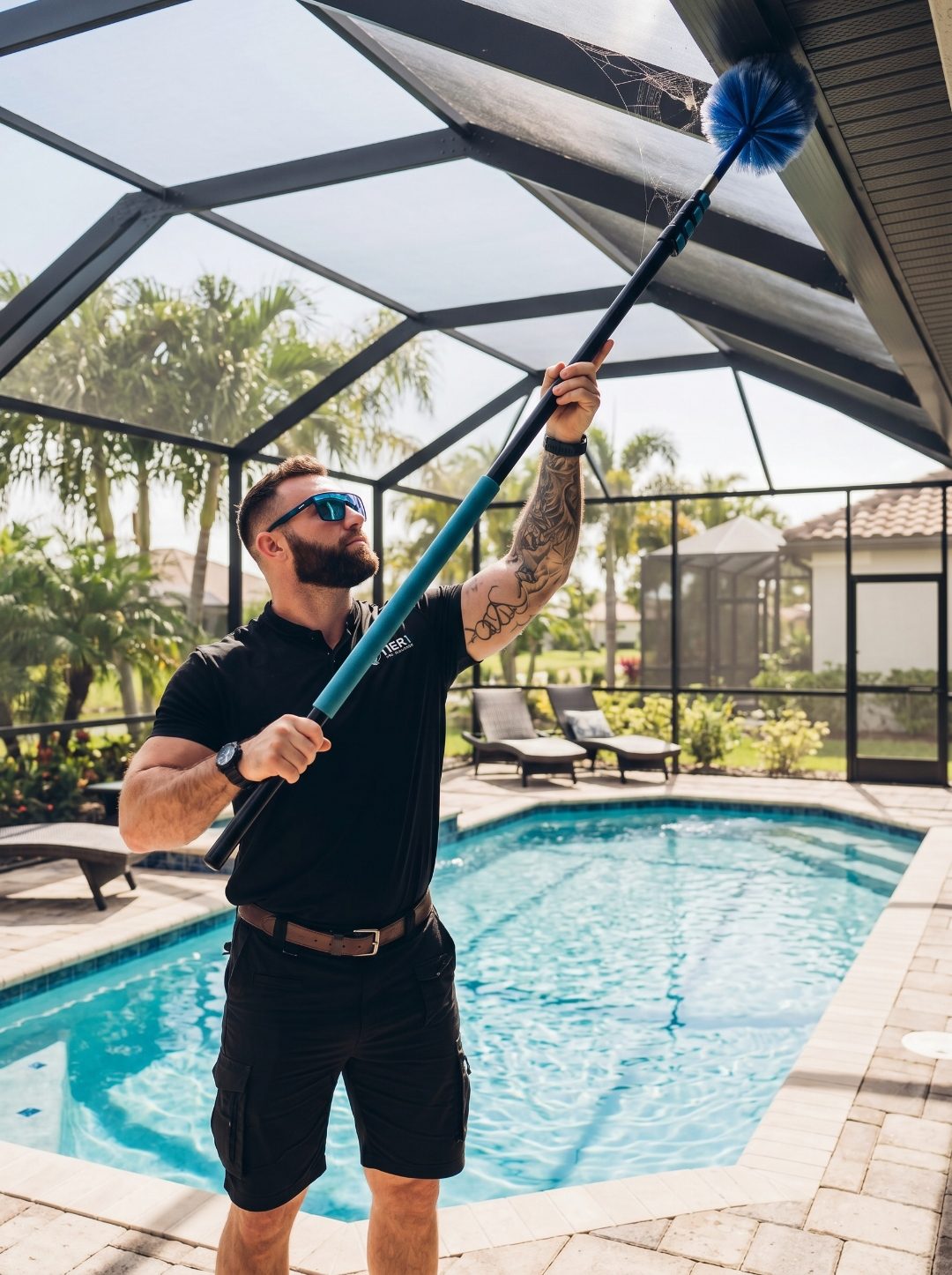
Tier 1 Pest Solutions technician removing spider webs from a Cape Coral FL pool enclosure
Complimentary Re-SweepsBetween Every Scheduled Visit
EPA-Approved ProductsProfessional-Grade Residual Treatment
Pool-Safe TreatmentsApplied to Structural Surfaces Only
Included with Pest Control PlansNo Extra Charge — Ever

Why This City Has Some of the Worst Web Problems in Florida

Cape Coral wasn't just built near water — it was engineered around it. The city's 400-plus miles of navigable canals make it one of the most waterway-dense cities on the planet, and that design choice has a direct consequence for every homeowner with a pool cage: persistent, relentless spider web pressure that outpaces virtually any other market in Florida. Understanding why helps explain why a one-time sweep never holds.

  • 400+ Miles of Canals = Unlimited Insect Production Cape Coral's canal network creates standing and slow-moving water across every corner of the city. This is ideal mosquito, midge, and gnat breeding habitat operating at enormous scale. Web-building spiders position themselves exactly where flying insects are most abundant — and in a canal city, that means your pool cage frame is prime real estate year-round.
  • Virtually Every Home Has a Pool Cage — It's Built Into the City's DNA Cape Coral was designed as an outdoor living city from the ground up. Screened pool enclosures are standard on the overwhelming majority of single-family homes here — far more so than comparable Florida cities. That means more total surface area of screen, beams, and frame channels for spiders to colonize across the entire metro. Cape Coral homeowners discuss this issue constantly on local Facebook groups because it affects almost every household.
  • Tropical Landscaping Touches the Cage Cape Coral's warm climate supports dense tropical plantings — palms, hibiscus, bird of paradise, bougainvillea, and banana trees are common in residential yards. When these plants grow against or over the pool cage, spiders have a direct, residual-free highway from the vegetation into your screen enclosure. Banana spiders (golden silk orbweavers) are particularly fond of anchoring their enormous golden webs from canal-side palms directly across pool cage frames.
  • Year-Round Activity — No Cold Season Relief Southwest Florida's climate means spider populations never crash seasonally. In most of the country, winter kills off a significant portion of spider populations and gives homeowners a break. In Lee County, spiders breed and feed every month of the year. The cycle never stops, which is why Cape Coral lanais need recurring professional service rather than a single annual treatment.
  • Outdoor Lighting Runs a Constant Insect Buffet Every lanai light on after dark is a bug magnet. Standard warm-white and cool-white LED fixtures emit wavelengths that draw moths, mosquitoes, gnats, and flying beetles at scale. Spiders are opportunists — they set up webs precisely where insect traffic is highest. Canal-adjacent yards in Cape Coral compound this: the proximity to water means more insects in the air around your home than inland neighborhoods experience.
  • Common Cape Coral Spider Species What you're likely seeing: golden silk orbweavers (banana spiders) spinning enormous yellow webs from palms across your cage; spiny orb-weavers in classic circular webs throughout beams and corners; jumping spiders patrolling screen panels; wolf spiders hunting across the lanai floor; and occasionally black widows establishing in dark corners near pool equipment or under stored furniture.
400+ Miles of canals in Cape Coral — more than Venice, Italy
365 Days of active spider season — no winter die-off in SW Florida
48 hrs How quickly spiders rebuild webs without residual treatment
FREE Re-sweeps between visits — included with every pest control plan
Why One Sweep Isn't Enough

A spider can rebuild a complete orb web in as little as one hour. Without treating the structural attachment points with residual product after sweeping, you're just clearing the way for a new web in the same spot — sometimes the same evening. Cape Coral's canal-fueled insect pressure makes this especially acute: there is always food available to draw spiders back. That's why our service always pairs the sweep with treatment — and why our complimentary re-sweep guarantee matters.

Southwest Florida pest specialists have documented that Cape Coral and the surrounding Gulf Coast corridor consistently rank among the most spider-active markets in the state — a direct result of the city's unique waterway design and year-round subtropical climate.

See our 3-step treatment

Our Lanai Spider Treatment

Three steps that actually work — sweep, treat, and guarantee. This is the difference between a temporary fix and lasting results in Cape Coral's canal environment.

01

Complete Web Sweep

We use professional extension poles and Webster brushes to reach every corner, beam, crossbar, screen corner, and ceiling of your lanai and pool cage. Every web comes down — including the small ones tucked in the frame channels that a standard broom can't reach. We also remove egg sacs, which is critical: a single egg sac can contain hundreds of spiderlings. If we leave the egg sacs behind, the problem returns in days. In Cape Coral, where banana spiders anchor webs from canal-side palms to your cage frame, we address those anchor points too — not just the visible web in the middle. We work the entire envelope of the enclosure systematically from top to bottom.

02

Residual Product Application

After the sweep, we apply EPA-approved residual insecticide to the structural beams, frame corners, and attachment points of your screen enclosure — the specific surfaces where spiders anchor their webs. This is the step that separates us from a simple sweep-only service. The residual product kills spiders on contact when they attempt to attach new webs, and it continues working for weeks. In canal-adjacent Cape Coral homes where spider pressure is constant, this residual layer is the difference between webs returning overnight versus staying clear for weeks. Product is applied to hard structural surfaces only — never to screen mesh, pool water, or open areas — making it safe for your family and pets during normal lanai use. If your mosquito misting system or mosquito fogging schedule overlaps with a lanai treatment, we coordinate accordingly.

03

Complimentary Re-Sweeps

Even with residual treatment, the reality of Cape Coral lanais is that some web activity will return between scheduled visits — especially for homes on canal lots, in Gulf-access communities, or with tropical vegetation touching the cage. That's why every Tier 1 general pest control plan includes complimentary re-sweeps at no extra charge. If webs start building back up between your monthly or bi-monthly service visits, call us. We'll schedule a return sweep at no additional cost. No service call fee. No per-visit charge. Just call. This guarantee is part of every plan — it's not something you have to ask for or negotiate. Our goal is a web-free lanai that you can actually use and enjoy year-round.

Why Spider Webs Keep Coming Back in Cape Coral

The biology of spiders combined with Cape Coral's unique canal environment explains why DIY sweeping alone is a losing battle — and what actually makes a lasting difference.

The Cape Coral Reality

  • Spiders rebuild webs within hours. An orb-weaver can reconstruct a full web in 30 to 60 minutes. Without residual treatment on the attachment points, removing a web just creates an opportunity for a new one in the same spot — sometimes before you've finished sweeping the other side of the cage.
  • The canal system runs a 24/7 insect production facility. Cape Coral's 400-plus miles of waterways mean that mosquitoes, midges, and gnats are being produced at scale across every neighborhood in the city. This isn't seasonal — it's perpetual. And web-building spiders are positioned to intercept that insect traffic right where it crosses your pool cage.
  • Tropical landscaping creates a residual-free highway into your cage. Palms, hibiscus, and other tropical plants that touch or overhang the screen enclosure give spiders a direct route inside without crossing treated surfaces. Banana spiders in particular are fond of anchoring their large golden webs from canal-side vegetation directly to pool cage beams.
  • Screen gaps and worn door sweeps let spiders walk in freely. Cape Coral's intense UV exposure degrades rubber and vinyl screen door sweeps quickly. A gap at the bottom of a screen door is enough for most spider species to enter freely — including black widows, which set up harborage near pool equipment pads in precisely these undisturbed entry points.

Homeowner Tips to Reduce Web Pressure

  • Switch to yellow or amber bug lights. Yellow-spectrum LED bulbs (2700K or lower) attract significantly fewer insects than standard cool-white or warm-white LEDs. In a canal city, every reduction in insect attraction around your lanai translates directly to fewer spiders moving in to catch them. This single change can make a noticeable difference within weeks.
  • Keep tropical plantings 12–18 inches back from the cage. Palms, hibiscus, bird of paradise, and any other vegetation that contacts the screen enclosure gives spiders a direct route inside. Trim branches and fronds that arch over the top of the cage — banana spiders especially use these as launch points for large webs across your pool cage frame.
  • Inspect and replace screen door sweeps annually. Cape Coral's UV exposure and humidity degrade door sweeps faster than inland areas. Check the rubber or vinyl sweep at the bottom of every screen door for cracks, compression, or gaps. Hardware stores carry universal screen door sweeps that install without tools in most cases.
  • Turn lanai lights off when not in use. Even a few hours of lights-on time after dark draws enough insects to attract multiple web-building spiders. Motion-sensor switches on lanai fixtures make it easy to keep lights off except when you're actually using the space — especially helpful on canal lots where insect pressure is highest after sunset.
  • Clear clutter from lanai corners and pool equipment areas. Black widows specifically seek dark, undisturbed spots — behind stored items, under chair cushions, near the pool pump and filter housing. Keeping the lanai organized and checking pool equipment areas periodically eliminates the harborage conditions they prefer.

Common Lanai Spiders in Cape Coral

Cape Coral's canal environment supports a robust spider community in pool cages. Knowing which spiders you're dealing with helps set expectations — most are harmless, but a couple require special attention.

Golden Silk Orbweavers
Trichonephila clavipes — Banana Spiders — Cape Coral's Most Visible

Cape Coral's banana spider problem is especially pronounced because of the canal-side palms and tropical landscaping that provide ideal anchor points for their enormous webs. Females can span 3–4 inches leg to leg and spin webs with golden-yellow silk up to three feet across — often anchoring from a palm frond directly across your pool cage frame at eye or shoulder level. The silk is exceptionally strong; walking into one feels like walking into fishing line. Despite their dramatic size and appearance, banana spiders are non-aggressive, rarely bite, and pose no medical risk. The web is nearly invisible in certain light, which is the real hazard — especially for guests who don't know to watch for them. Their presence is a reliable indicator of high insect activity from nearby canal waterways.

Harmless — intimidating but non-aggressive
Spiny Orb-Weavers
Gasteracantha cancriformis — Most Common Web Builder

These are the spiders you'll find all over your pool cage beams and screen corners. Small — about the size of a quarter — with a flat, hard abdomen that looks almost crab-like, covered in colorful spines. Coloring ranges from white to yellow to orange-red, usually with black spines. They build classic circular orb webs, often in clusters throughout the cage frame. A single Cape Coral pool cage can host dozens of them simultaneously, especially during late summer and fall when populations peak. Despite their unusual appearance, spiny orb-weavers are completely harmless to people — they don't bite aggressively and have no medically significant venom. Their webs are their only problem, and they build new ones quickly without residual treatment.

Harmless
Black Widows
Latrodectus mactans — Use Caution

The one Cape Coral lanai spider that warrants genuine caution. Black widows are jet black — sometimes with a red hourglass marking on the underside of the abdomen — and build irregular, messy cobweb tangles in sheltered corners, under lanai furniture, near pool equipment pads, and in any dark, undisturbed spot. They're especially fond of the area around pool pump and filter housings, where homeowners often reach without looking. Their egg sacs are smooth, round, and papery — look for them in corners near where you've spotted the spider. Black widow bites are medically significant and cause severe local pain, muscle cramping, and can require medical treatment. If you find black widows in your lanai or near your pool equipment, mention it specifically when you call — we'll pay extra attention to those harborage areas and treat them thoroughly.

Venomous — seek medical attention if bitten
Wolf Spiders & Jumping Spiders
Lycosidae / Salticidae — No Web, Active Hunters

Wolf spiders are large, fast, and alarming — but they don't build webs. They're ground hunters that actively chase down prey, which is why you'll find them running across lanai floors, around pool edges, and occasionally across furniture. In Cape Coral, canal moisture means wolf spiders have ample hunting grounds in the yard and frequently wander into the lanai through gaps in door sweeps. They can reach an inch and a half in body length with a legspan of up to 4 inches for larger females. Wolf spiders carry their egg sac and young on their body — disturbing one can scatter dozens of spiderlings instantly. Jumping spiders are smaller and distinctly athletic; they patrol screen panels and furniture looking for small insects. Both are essentially harmless to people, though their speed and sudden movements are frequently startling to homeowners and guests.

Harmless — no web, but fast and startling

Included with Your General Pest Control Plan

Lanai web sweeping and screen enclosure treatment is not a separate service line. It's not an add-on. It's not something you pay extra for. When you're on a Tier 1 general pest control plan — monthly or bi-monthly — your technician sweeps the lanai and treats the frame on every scheduled visit as a standard part of the service.

And if webs come back between visits — which in Cape Coral canal neighborhoods they will — our complimentary re-sweep policy means you just call. We come back out and re-sweep at no charge, no matter how many times it takes. We don't win by making you pay every time spiders return. We win when your lanai stays clean and you stay on the plan. Our Fort Myers pest control team services the entire Lee County corridor including all of Cape Coral.

  • Full lanai web sweep at every scheduled visit — no extra charge
  • Residual treatment applied to beams and frame after each sweep
  • Complimentary re-sweeps between visits — unlimited, included in your plan
  • Egg sac removal — we remove all egg sacs, not just visible webs
  • Pool-safe application — product applied to structural surfaces only
  • Available on both monthly and bi-monthly plans
Get Started Today See General Pest Control Plans
What's Included

Everything, No Surprises

A lot of pest control companies treat lanai sweeping as an optional service tier or charge per-visit fees for re-sweeps. We don't. Our general pest control plans are designed to cover the whole property — including the lanai — and our re-sweep policy means you can call us when webs come back without getting a bill for it.

  • Interior treatment (kitchen, bathrooms, baseboards)
  • Exterior perimeter and eave treatment
  • Yard treatment (fire ants, fleas, ticks, lawn pests)
  • Lanai web sweep and screen cage treatment
  • Unlimited complimentary re-sweeps between visits
  • EPA-approved products, family and pet safe
Get a Free Quote

What Sets Us Apart

We work in Cape Coral and the surrounding Lee County communities every week. We know these lanais — the Gulf-access communities with the heaviest canal exposure, the neighborhoods where banana spiders anchor webs from canal-side palms, and the pool equipment areas where black widows establish. Our Fort Myers pest control team is the same team serving Cape Coral — this is local knowledge, not a call center dispatching a contractor you've never met.

Re-Sweeps with Zero Friction

Call us, tell us webs are back, and we schedule a return. No service call fee, no "that's not covered," no negotiation. Our re-sweep policy is unconditional and it's a real promise — not fine-print language that evaporates when you try to use it. Cape Coral canal homes may need this more than any other market we serve, and that's built into our plans.

We Sweep and Treat — Not Just Sweep

Any company can run a Webster brush through a lanai. What prevents webs from coming back within a day is the residual application to the structural attachment points. We do both at every visit, every time. In Cape Coral's canal environment, where spider pressure is constant and food supply is unlimited, a sweep without treatment is a service you'll need again in 48 hours.

Egg Sac Removal Every Time

Most technicians sweep visible webs and move on. We specifically look for and remove egg sacs — which can contain hundreds of spiderlings each. Missing the egg sacs means the next generation hatches inside your lanai a week after the sweep. We don't let that happen, and we pay particular attention to egg sacs in pool cage frame channels where they're easy to miss.

Local Team, Local Knowledge

We know that Tarpon Point and Cape Harbour waterfront homes have different lanai layouts than Sandoval or Coral Oaks. We know banana spiders peak along canal lots in late summer. We know black widows concentrate near pool equipment in SW Cape Coral as well as Gulf-access communities in NW Cape Coral. This comes from doing the work here every week — not from a training manual.

Real Google Reviews

Frequently Asked Questions

Everything Cape Coral homeowners ask us about lanai spider web removal and prevention in pool cages and screen enclosures.

In Cape Coral, most lanais benefit from web sweeping at every pest control visit — monthly or bi-monthly depending on your plan. Cape Coral's canal-dense environment means insects are extraordinarily abundant year-round, which keeps spider populations active and hungry twelve months a year without any seasonal die-off. Homes on canal lots, in Gulf-access communities, or with tropical landscaping touching the cage typically see webs rebuild faster than homes with less surrounding vegetation. Between scheduled visits, our complimentary re-sweep policy means you just call us and we come back out at no additional charge.
The most common web-builders in Cape Coral pool cages are golden silk orbweavers (banana spiders) — large yellow-and-black spiders that spin enormous golden webs up to three feet across, often anchoring them from canal-side palms through your screen to the cage frame. Spiny orb-weavers build classic circular webs throughout the beams and corners. Jumping spiders hunt along the screen panels without building webs. Wolf spiders prowl the lanai floor. Black widows occasionally establish in dark, undisturbed corners near the pool equipment pad or under furniture. The canal system's constant moisture supports an insect population that makes Cape Coral ideal spider habitat year-round.
Most spiders found in Cape Coral lanais are harmless. Golden silk orbweavers (banana spiders) and spiny orb-weavers are non-aggressive and pose no medical risk despite their size and dramatic appearance. Wolf spiders and jumping spiders can bite if cornered but produce only minor, localized discomfort. The one spider that warrants genuine caution in Cape Coral is the black widow — jet black with a red hourglass marking on the underside. Black widow bites are medically significant and require prompt attention. They favor dark, sheltered spots: pool equipment areas, under furniture, inside stored items. If you find black widows, mention it when you call — we'll prioritize those harborage areas during treatment.
Cape Coral's 400-plus miles of navigable canals create constant moisture throughout the city, which supports enormous populations of mosquitoes, midges, gnats, and other flying insects — exactly the prey web-building spiders hunt. Without residual treatment on the structural attachment points after a sweep, spiders simply rebuild within hours. The tropical landscaping common in Cape Coral — palms, hibiscus, bird of paradise — often contacts or overhangs pool cages, giving spiders a direct route in from surrounding plants. Canal-adjacent yards compound this by maintaining the humidity and insect density that keeps spiders well-fed and breeding year-round.
Yes. We use only EPA-approved, professional-grade residual products formulated for use in structures including screen enclosures around pools. The products we apply to structural beams and frame corners are safe once dry. We apply product to hard surfaces only — not to screen mesh, pool water, or open areas — and standard dry time before resuming normal lanai use is typically 20 to 30 minutes. If you have specific concerns about chemical sensitivities or would prefer a lower-impact formulation, just let us know before your visit and we'll discuss your options.
Yes — lanai web sweeping and residual treatment of your screen enclosure is included in our general pest control plans. It is not a separate add-on or upcharge. Whether you're on a monthly or bi-monthly plan, your technician sweeps the lanai, removes all webs and egg sacs, and applies residual product to the frame on every scheduled visit. Additionally, if webs start building back between visits — which they will in Cape Coral, especially in canal-adjacent homes — our complimentary re-sweep policy means you call us and we come back out at no extra charge. This is part of what makes our general pest control plans genuinely comprehensive for Cape Coral homeowners who use their lanais and pool cages year-round.

Ready for a Web-Free Lanai?

Fill out the form and we'll reach out to schedule your free quote. Lanai web sweeping and treatment is included with our general pest control plans — monthly or bi-monthly — with complimentary re-sweeps when webs come back. We serve all of Cape Coral including SW Cape Coral, NW Cape Coral, SE Cape Coral, NE Cape Coral, Tarpon Point, Cape Harbour, Sandoval, Coral Oaks, Trafalgar, Burnt Store Marina, and all Gulf-access communities. Or give us a call directly.

Hours Monday – Friday, 8:00 AM – 5:00 PM
Address 3902 Corporex Park Dr, Suite 450, Tampa, FL 33619

Get a Free Quote

Cape Coral Area Communities We Serve

We work across Cape Coral and the greater Lee County area every week — from Gulf-access waterfront communities and the Yacht Club neighborhood to master-planned communities like Sandoval and Coral Oaks, and neighboring cities from Fort Myers to Bonita Springs.

SW Cape Coral
NW Cape Coral
SE Cape Coral
NE Cape Coral
Tarpon Point
Cape Harbour
Sandoval
Coral Oaks
Trafalgar
Pelican / Pelican Pointe
Burnt Store Marina
Yacht Club Area
Rotary Park Area
Gulf Access Communities
North Fort Myers
Fort Myers Beach
Sanibel & Captiva
Pine Island (Bokeelia, St. James City, Matlacha)
Lehigh Acres
Gateway

We also serve nearby Naples and surrounding Collier County communities. Not on the list? Call (813) 548-6341 to confirm coverage in your neighborhood.

Also serving the greater Tampa Bay area — see our Wesley Chapel lanai spider control page for Pasco County coverage details.

Call Now Free Quote