Tampa's #1 Rodent Removal Specialists — Ranked #1 City in the US for Rodents

Roof Rats in Your Tampa Attic? We Get Them Out and Keep Them Out.

That scratching at night isn't in your head — it's roof rats nesting in your insulation and chewing your wires. Tampa ranks #1 in the country for rodent pressure. We inspect free, seal every entry point, trap the population, decontaminate, and prevent them from coming back. 50% off your first service.
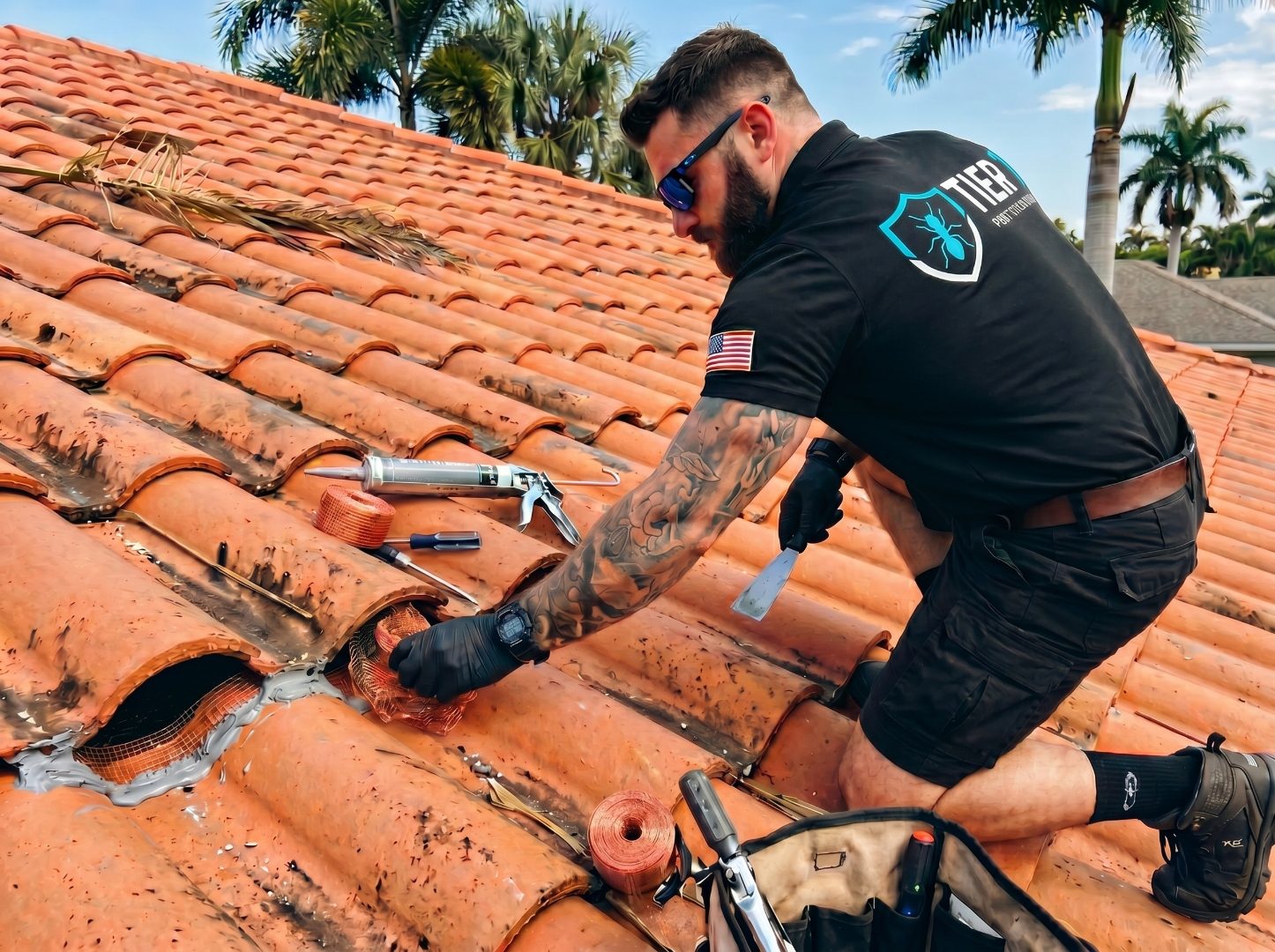
Tier 1 Pest Solutions technician performing attic roof rat inspection in Tampa FL
Free Attic InspectionNo Charge — Ever
Exclusion-First ProtocolWe Seal Before We Trap
Family & Pet SafeNo Rodenticide Inside the Home
50% Off First ServicePermanent Promo — Tampa Area

Why Tampa Is #1 in the Country for Roof Rats

Aptive's 2026 rodent forecast ranks Tampa the #1 rodent-pressure city in the United States — above Houston, Miami, and New Orleans. If you're a Tampa homeowner hearing scratching in your attic, you're not unlucky. You're in the epicenter. Understanding why Tampa has this problem explains why generic DIY responses fail here when they might work elsewhere, and why professional rodent control in Tampa requires a different level of thoroughness.

  • Year-Round Warmth — No Population Kill-Off Winter In most of the country, freezing winters kill a significant percentage of the rat population and give homeowners a natural reprieve. Tampa's subtropical climate means temperatures rarely dip below 50°F at night even in January. Roof rats breed and forage 365 days a year here with no seasonal slowdown. The colony that starts in October doesn't die back — it grows through winter.
  • Abundant Citrus, Palms, and Year-Round Fruit Tampa Bay neighborhoods are saturated with citrus trees — grapefruit, orange, lemon — and roof rats are specifically attracted to citrus. They hollow out fruit from the inside, leaving the peel intact. Palm trees provide ideal nesting material and elevated travel corridors. If your yard has citrus or palms touching or overhanging your roofline, you have a direct on-ramp for roof rats into your attic.
  • Connected Tree Canopies Act as Elevated Highways In established Tampa neighborhoods — South Tampa, Carrollwood, Temple Terrace, Westchase, and New Tampa alike — mature oak and citrus canopies touch and overlap across property lines, creating continuous above-ground travel corridors. Roof rats move from tree to tree without touching the ground, arriving directly at your roofline from neighbor properties. Trapping one house means nothing when the supply corridor runs unbroken for blocks.
  • Older Homes with Deteriorating Soffits and Roof Vents A large proportion of Tampa's housing stock was built between the 1950s and 1990s. Wood fascia, aging vinyl soffits, and original roof-vent boots deteriorate over time, creating gaps wide enough for a roof rat — which can compress its body to squeeze through a hole the diameter of a quarter. Many homeowners have entry points they've never noticed because they're at roofline elevation and invisible from the ground.
  • Attic Heat Mimics Preferred Nesting Climate A Tampa attic in summer reaches 130–150°F during the day. But at night, after the sun sets, attic temperature drops to 80–95°F — warm, dark, and protected from predators. That's exactly the nesting climate roof rats prefer. Combined with abundant insulation for burrowing and material shredding, Tampa attics are essentially purpose-built roof rat habitat.
  • Lush Landscaping and Dense Ground Cover Tampa's humidity sustains dense ornamental plantings, ground cover, and hedges year-round. This landscaping provides daytime shelter, food sources, and protected travel routes for roof rats moving from neighboring properties toward your home's roofline. Overgrown hedges touching the foundation or dense landscaping near the home's perimeter create a comfortable staging area before the climb.
#1 Tampa ranked #1 rodent city in the US — Aptive 2026 forecast
21 days How fast roof rats breed — one pair becomes dozens within months
365 Days of active breeding — Tampa has no cold-weather kill-off
FREE Attic and exterior inspection — no charge, no obligation
Why Tampa Needs Exclusion, Not Just Trapping

In a connected tree-canopy city like Tampa, the pressure to re-enter your home never stops. As long as entry points exist, trapping is a treadmill — you remove rats and more arrive within days. The only effective long-term solution is sealing the structure first, then eliminating the remaining population. See our full Tampa rodent control process.

See the exclusion process

Roof Rats vs. Norway Rats vs. Squirrels

Correct identification determines the right treatment approach. These three common attic pests require different removal strategies — here's how to tell them apart in a Tampa attic.

Most Common in Tampa

Roof Rat (Rattus rattus)

  • Body 6–8 inches; tail longer than body — key diagnostic
  • Sleek black or dark brown coat; large ears; pointed nose
  • Exceptional climbers — travel via trees, power lines, fences to rooflines
  • Prefer upper levels: attics, ceiling voids, wall cavities above ground floor
  • Strictly nocturnal — active after sunset, quiet during the day
  • Droppings: small (½"), dark, spindle-shaped with pointed ends
  • Leave grease marks (sebum) along rafters and beam edges
Ground-Level Burrower

Norway Rat (Rattus norvegicus)

  • Larger and bulkier body (8–10"), blunt snout, small ears
  • Tail is shorter than body — opposite of roof rat
  • Brown or gray-brown coat; coarser fur
  • Ground-dwelling burrowers — found under slabs, in crawl spaces, near garbage
  • Poor climbers — rarely found in upper attics in Tampa
  • Larger droppings (¾"), capsule-shaped, blunt ends
  • Less common in Tampa attics — primarily a sewage and foundation pest
Daytime Activity

Gray Squirrel (Sciurus carolinensis)

  • Larger body (8–11"), distinctive bushy tail — unmistakable
  • Diurnal (daytime active) — noise starts at sunrise, stops at dusk
  • Heavier movement sounds — louder thumping vs. rat's quick scurrying
  • Gray or reddish-brown; white belly; round, chunky build
  • Droppings larger and more rounded vs. rat droppings
  • Not nocturnal — if attic noise is only at night, it's not squirrels
  • Requires different exclusion and permit considerations vs. rodents

Not sure what you have? In Tampa, if you're hearing scratching, scurrying, or rolling sounds after dark in your attic or ceiling, the odds are overwhelmingly roof rats. Our free attic inspection will confirm species, map every active runway and nesting area, and identify every entry point — all at no charge. See our full rodent control service page for more information on the species we handle.

Signs You Have Roof Rats in Your Tampa Attic

Roof rats leave a recognizable pattern of evidence. If you're checking multiple boxes below, you almost certainly have an active infestation — and the longer it continues, the worse the contamination and structural damage.

  • Scratching or Scurrying at Night in Ceiling or Attic Roof rats are nocturnal. The rapid scratching and scurrying sounds that start after sunset and peak in the first hour of darkness are the #1 reported symptom from Tampa homeowners. The sounds often come from directly overhead or along the ceiling-to-wall junction where they run their established routes.
  • Small Dark Droppings in Insulation Roof rat droppings are approximately ½ inch long, dark brown to black, with pointed ends at both tips — spindle-shaped. Finding droppings in attic insulation confirms active presence. A single rat produces 40–50 droppings per day; a colony of 10 leaves thousands in your insulation weekly.
  • Gnawed Electrical Wires, PVC, or Stored Items Roof rats gnaw constantly — their incisors grow throughout their life and they must chew to maintain them. Gnawed Romex wiring, chewed PVC conduit, and shredded stored cardboard boxes in the attic are direct physical evidence. Chewed wiring creates genuine fire risk — this is not a cosmetic concern.
  • Grease Marks Along Rafters and Beam Edges Roof rats are creatures of habit and run the same routes every night. Their oily fur deposits a visible dark grease smear on rafters, beams, and wall edges along their travel paths. These smear marks are called "runways" or "rub marks" and are among the most reliable diagnostic signs — they confirm not just presence but active routes to place traps.
  • Citrus Fruit with Holes Hollowed From the Inside This is one of the most Tampa-specific signs of roof rats. If you find grapefruit, oranges, or lemons in your yard with a small hole and the interior completely hollowed out — the peel intact — that's classic roof rat feeding behavior. They consume the pulp and leave the rind.
  • Urine Stains or Ammonia Smell in Attic Roof rat urine glows under UV light — a tool our technicians use during inspection. The accumulated ammonia smell in an attic with an established infestation is often described as strong and acrid. Urine-contaminated insulation must be removed and replaced due to hantavirus risk.
  • Nests of Shredded Insulation, Paper, or Fabric Roof rats build golf-ball-to-softball-sized nests from shredded insulation, paper, fabric, and plant material. These are typically found in corners of the attic, between joists, or tucked behind HVAC equipment. Finding a nest confirms active habitation, not just passing through.
Don't Wait — The Math Gets Worse Fast

A Pair of Roof Rats Becomes
Hundreds in One Season

Roof rats reach sexual maturity in about 3 months and have litters of 5–8 pups every 21–28 days. A single breeding pair that enters your Tampa attic in the fall can produce a colony of 50–100+ by spring with no intervention. Each generation of pups begins breeding at 3 months old. The math compounds aggressively.

At the same time, contamination accumulates linearly with population. What starts as a nuisance becomes a significant health and property-damage issue within one season. Tampa's year-round warmth means this process never hits pause.

Book Free Attic Inspection
WHAT WE LOOK FOR IN YOUR ATTIC
  • Active runways and nesting areas
  • Every entry point (gap as small as ¼")
  • Contamination extent in insulation
  • Chewed wiring and duct damage
  • Population size estimate

Why Roof Rats Are a Serious Problem — Not a Minor Nuisance

Tampa homeowners often underestimate the scope of a roof rat infestation. The risks span from documented disease transmission to house fires from chewed wiring. Here's the full picture.

Health & Property Risks

  • House Fire from Chewed Wiring — Gnawed electrical wiring is one of the top identified causes of unexplained house fires in Florida. Roof rats chew the insulation from Romex wires, creating exposed conductors that arc and ignite attic insulation. Because the ignition point is in the attic, these fires are often well-advanced before smoke reaches living spaces.
  • Hantavirus Pulmonary Syndrome — Transmitted through contact with or inhalation of dried rodent urine, droppings, or saliva. Hantavirus is rare but has a high mortality rate. The risk is highest when disturbing contaminated attic insulation without proper respiratory protection — including during HVAC filter changes, attic access, or insulation work by contractors who don't know the attic is contaminated.
  • Leptospirosis — A bacterial infection spread through rat urine contaminating water or surfaces. Leptospirosis enters the body through cuts, mucous membranes, or eyes. In Tampa's humid environment, urine from attic-dwelling rats can migrate through gaps into wall cavities and eventually surfaces in living areas.
  • Salmonellosis — Roof rats commonly carry Salmonella and contaminate surfaces, food storage areas, and pantries when they access kitchen areas at night. Food stored in attic spaces (camping supplies, bulk dry goods) is particularly vulnerable to contamination.
  • Insulation R-Value Loss — Roof rats tunnel through and nest in attic insulation, compressing it severely. Compressed insulation loses R-value proportionally — meaning your HVAC system works harder, your energy bills increase, and the temperature differential in living spaces becomes noticeable. A heavily infested attic can lose 30–50% of its effective R-value.
  • HVAC Contamination — Droppings, urine, and fur accumulating near air handler return vents or in ductwork means contaminated air is circulating through your living spaces. HVAC technicians routinely discover active or past rodent infestations during maintenance that homeowners had no idea existed.
  • Chewed PVC and Plumbing Damage — Roof rats chew PVC pipe in attic spaces — both supply and drain lines. A slow leak from a gnawed PVC fitting in the attic can cause significant moisture damage and mold growth before it becomes visible from below.

Why DIY and Poison Bait Fail in Tampa

  • Bait Stations Don't Address Entry Points — Rodenticide kills rats that eat it, but does nothing to prevent more rats from entering through the same gaps. In Tampa's connected-canopy environment, new rats arrive continuously from neighboring properties. Without exclusion, bait stations are a perpetual treadmill — you're killing rats faster than they breed, which is mathematically impossible without sealing the structure.
  • Poison Creates Dead-Rat-in-Wall Odor — When a rat ingests rodenticide and dies inside your walls or attic, the decomposition creates a severe odor that can persist for 2–4 weeks, attracts blowflies that infiltrate the living space, and requires opening walls to locate and remove the carcass. This is one of the most common calls we receive: homeowners who used store-bought poison and now have a rotting-odor problem to resolve on top of the original infestation.
  • Rats Reproduce Faster Than You Can Trap Without Exclusion — A female roof rat produces a new litter every 21–28 days with 5–8 pups per litter. Without sealing entry points, you cannot trap your way to zero population because new animals are constantly supplementing the breeding colony. Exclusion first — seal before you trap — is the only method that actually works.
  • Retail Traps Miss the Runways — Snap traps placed in random locations in the attic catch almost nothing. Effective trap placement requires identifying the specific runways (greased rafter edges, beam tops) where rats travel habitually. Traps placed on runways catch many times more rats per trap than those placed on the attic floor or in random corners.
  • Entry Points Are Often Invisible from Ground Level — The gaps roof rats use to enter — deteriorated soffit vents, failing roof boot seals, AC line penetrations, gable vent screens — are at roofline elevation and typically not visible without ladder access and a trained eye. Most homeowners attempting DIY exclusion miss several entry points, which means the problem continues despite their efforts.

The correct order is: seal first, then trap. Tier 1 completes exclusion — sealing every identified entry point — before trapping begins. This means the remaining population inside has no exit and no reinforcement, and can be fully eliminated. See our rodent control page or general pest control plans for coverage options.

Get a Free Attic Inspection

The Tier 1 Attic Rodent Control Process

Six detailed steps — designed specifically for Tampa's year-round rodent pressure. Every step matters. Skipping any one of them is why other approaches fail.

01

Free Attic & Exterior Inspection — Find Every Entry Point

We start with a complete inspection of your attic interior and a full walk of the exterior at roofline level. Inside the attic, we document active runways using grease smear patterns, locate nesting areas, assess contamination extent in insulation, and check for damaged wiring and ductwork. Outside, we systematically inspect every point where roof rats can enter — and there are more than most homeowners expect.

Common entry points in Tampa homes include: soffit gaps (especially at corners and where the soffit meets the fascia), roof-vent boots (the rubber collars around plumbing vents that crack and shrink with age), AC line penetrations (the entry point for refrigerant lines and electrical through the exterior wall), gable vents (often with deteriorated or missing screens), chimney gaps, construction gaps at roofline junctions, and damaged or missing roof tiles on barrel-tile roofs common in South Tampa and Brandon. The inspection is free — no charge, no obligation. A written quote is provided before any work begins.

02

Seal & Exclude — Galvanized Steel Mesh, Steel Wool, and Foam

This is the step that makes everything else work. We seal every identified entry point before a single trap is set. The materials depend on the gap type and location. For larger gaps at soffit returns and gable vents, we use galvanized hardware cloth (steel mesh) that rats cannot chew through — standard window screen mesh is not sufficient, as roof rats chew through it easily. For smaller gaps and irregular penetrations, we combine steel wool packing with expanding foam — the foam alone is insufficient because rats chew through cured foam readily, but steel wool combined with foam is highly effective.

AC line penetrations are sealed around the conduit with the appropriate combination of foam and mesh. Roof boot collars that have failed are replaced. Gable vent screens are repaired or replaced with hardware cloth. The critical principle is this: we seal before we trap. If we trapped first and sealed after, we'd be trapping an open population being continuously supplemented from outside. Seal first, and we're eliminating a fixed, finite population with no reinforcements and no exit.

03

Trap & Remove — Snap Traps on Active Runways

With the structure sealed, we place snap traps on the active runways identified during inspection — typically on top of rafters, along beam edges, and at the intersections where we observed grease smear marks. Snap traps placed on runways catch dramatically more rats than those placed randomly. We use professional snap traps, not the light-duty retail versions that rats frequently trip without being caught.

Trapping is monitored regularly until all trap activity ceases. Caught rats are removed and disposed of cleanly — no rotting carcasses, no odor issue. Depending on the population size, the trapping phase typically runs 1–3 weeks from the date of exclusion. We do not leave the process unattended — if traps are triggering, we're monitoring. Once there has been no trap activity for several consecutive check intervals, we confirm the population is eliminated. Trapping is included in the exclusion service; there is no separate trapping charge.

04

Decontaminate — Remove Contaminated Insulation, Sanitize, Deodorize

Once the population is eliminated, decontamination addresses the health risk and eliminates the residual scent trails that attract future rodents. Roof rats communicate through urine scent marks — they follow established scent trails back to the same access points and nesting areas repeatedly. Without decontamination, even a perfectly sealed attic can attract new rodent activity faster because the scent profile of the old infestation signals to other rats that this is an established habitat.

Decontamination includes removing heavily contaminated insulation sections (particularly nesting areas and heavily marked runways), applying a hospital-grade disinfectant to attic surfaces (joists, decking, HVAC equipment), and deodorizing to break down urine-based attractant compounds. The scope of decontamination is based on the extent of contamination found during inspection — we don't charge for a full attic decontamination when only a section needs attention.

05

Repair — TAP Insulation Replacement Option

Where insulation has been removed due to contamination, or where the existing insulation has been so severely compressed by nesting activity that its R-value is materially impaired, we offer TAP insulation as a replacement option. TAP (Thermal, Acoustical, Pest Control) is a blown-in cellulose insulation treated with boric acid — the same borate compound used in many professional pest control products.

Insects that contact TAP insulation ingest borate during grooming and die — making it effective against cockroaches, ants, silverfish, and other crawling insects that commonly colonize attic insulation. TAP is Energy Star certified, provides excellent R-value per inch (higher than standard fiberglass batt), and is a permanent pest control solution — it does not lose its borate treatment over time. For Tampa homeowners replacing insulation after a rodent infestation, the incremental cost of TAP over standard insulation is almost always worth it: you're already doing the installation, and TAP provides pest protection and energy efficiency improvement that standard insulation doesn't.

06

Prevention — Tree Trimming Recommendations & Exterior Monitoring

The final step is reducing the risk of re-infestation. We provide specific tree trimming recommendations — the standard is keeping all tree branches at least 6 feet from the roofline and 8 feet from exterior walls. In Tampa's canopy-connected neighborhoods, this requires trimming not just your own trees but coordinating with neighbors in some cases. We'll identify the specific branches and access points to address.

For properties with ongoing pressure (dense canopy, adjacent vacant lots, or neighboring properties with known rodent activity), we can establish exterior tamper-resistant monitoring stations that allow us to detect new activity before it becomes an established attic infestation. We also advise on citrus management (pick up fallen fruit), trash storage (sealed containers, no overnight outdoor storage), and garage door threshold conditions. Re-inspection every 12–18 months is recommended for Tampa properties — new gaps can develop at roof boots and AC penetrations over time.

Emergency Response Available

Hearing Scratching Tonight?

Book a free attic inspection — we'll find every entry point, assess the contamination, and give you a clear written quote. No pressure, no obligation. Tampa's #1 rodent problem requires a Tampa-specific solution. We've done this in every neighborhood from South Tampa to Wesley Chapel to Brandon.

50% off first service · Free inspection · No obligation quote · FL License JB321482 | JE132152

What Sets Us Apart

We work in Tampa Bay neighborhoods every week. We know the specific construction patterns in South Tampa that create soffit gaps, the tree-canopy layout in New Tampa that forms rat highways, and the AC penetration failures common in Westchase homes built in the late 1990s. This is locally-grounded Tampa rodent removal expertise — not a national franchise dispatching a general technician to a city they don't know.

Exclusion First — Always

We seal before we trap. This is the only methodology that actually resolves a Tampa roof rat infestation long-term. Many companies trap first and seal later (or not at all). We seal every entry point before a trap is set, ensuring the population we're trapping is finite and the structure is permanently protected against re-entry once they're gone.

No Rodenticide Inside the Home

We don't use interior rodenticide bait as part of our standard protocol — ever. This means no dead-rat-in-wall odor, no decomposition, no blowfly problem, and no secondary poisoning risk to pets. Our trap-and-remove methodology keeps carcass management clean and controlled. Safe for households with pets and children.

Written Quote Before Any Work Begins

After the free inspection, we provide a clear, itemized written quote covering exclusion scope, trapping, and any recommended decontamination or insulation work. You approve the quote before we touch anything. No surprise charges, no scope creep, no "we found additional entry points halfway through and the price doubled." The quote is the price.

Tampa Local — We Know These Neighborhoods

Our technicians work in Tampa Bay neighborhoods year-round. We've done roof rat exclusions in South Tampa Victorian-era homes, Westchase tract homes from the 1990s, and New Tampa developments. We know the construction-era-specific failure points, the tree canopy patterns, and the neighbor-to-neighbor spread dynamics that define roof rat pressure in each area. See our Tampa pest control service page for the full area we cover.

What Roof Rat Removal Costs in Tampa

No surprises. Here's exactly how our pricing works — before you call.

FREE
Attic & Exterior Inspection
Complete attic inspection — runways, nesting areas, contamination extent, wiring damage — plus full exterior walk at roofline level identifying every entry point. No charge, no obligation. Written quote provided after inspection.
Custom
Exclusion & Trapping
Exclusion is priced by the number and complexity of entry points found during inspection. Trapping is included — not a separate line item. A home with two standard soffit gaps is priced differently than one with multiple AC penetrations, gable vents, and failing roof boots. You'll see the exact scope and price before we start.
Optional
Decontamination & TAP Insulation
Decontamination is recommended when contamination is significant — priced by scope after inspection. TAP insulation replacement is priced per square foot and is an optional upgrade over standard blown-in material. Neither is required unless the inspection identifies contamination that warrants it.
50% Off Your First Service — Active Promo

All new customers receive 50% off their first pest control service. Applies to general pest control plans that include rodent monitoring and exclusion work. Call to confirm applicability to your specific quote.

Call (813) 548-6341

Real Google Reviews

Prevention Tips That Actually Reduce Roof Rat Pressure

After exclusion work is complete, these measures reduce the likelihood of new pressure from outside your home. They won't stop a determined roof rat from attempting entry, but they reduce attractant and access significantly.

Trim Tree Branches 6+ Feet from the Roofline

This is the single most impactful prevention measure for Tampa homes. Any tree branch that can be used as a bridge to your roofline is a direct access ramp. The recommended clearance is 6 feet from the roofline and 8 feet from exterior walls. This includes branches from your neighbors' trees that overhang your property — worth a polite conversation. Palm trees adjacent to the home are particularly important to manage, as rats climb palm trunks easily and use the fronds as perches above rooflines.

Pick Up Fallen Citrus and Manage Fruit Trees

Citrus is one of the primary food attractants for roof rats in Tampa. Fallen grapefruit, oranges, and lemons left on the ground create a persistent food source that draws roof rats to your yard nightly. Pick up fallen fruit promptly — don't let it accumulate. For heavy-producing citrus trees directly adjacent to the home, consider whether the proximity justifies the ongoing attractant pressure. Tree placement relative to roofline access matters more than most Tampa homeowners realize.

Store Trash in Sealed, Secure Bins

Unsecured trash cans — particularly any with broken lids or organic waste — are a reliable food source for roof rats and a strong reason to establish territory near your home. Use hard-sided trash containers with locking or secure-fitting lids. Don't leave trash bags out overnight without a container. If you have compost, use an enclosed bin rather than an open pile adjacent to the home. Eliminating food sources makes your property less attractive relative to alternatives.

Seal Garage Door Threshold Gaps

Garage doors are a frequently overlooked entry point. A garage door threshold seal that is worn, cracked, or missing allows roof rats to enter the garage — which often has direct attic access through a pull-down stair or unsealed wall. Replace worn garage door threshold seals and side seals. Check that the door sweeps flat against the concrete with no daylight visible under the door. If your garage has attic access, confirm the access door fits tightly and has no gaps around the frame.

Eliminate Dense Ground Cover Near the Foundation

Thick ground cover plantings — jasmine, ivy, and ornamental grasses — immediately adjacent to the home's foundation provide shelter and protected travel routes for rats approaching the roofline. Keep a clear zone of at least 12–18 inches between dense plantings and the exterior wall, and make sure ground cover isn't creating covered pathways between neighboring properties and your foundation. Thinning overgrown hedges removes the daytime harbor sites that make your yard attractive staging ground for nighttime roof runs.

Annual Roofline Inspection for New Gaps

Even a properly sealed home can develop new entry points over time. Rubber roof boots crack with UV exposure (particularly intense in Tampa). AC conduit penetration foam shrinks and separates. Vinyl soffit panels sag or pull away at corners after severe weather. Schedule a roofline inspection every 12–18 months, particularly after significant wind events or after any HVAC work that required access through the exterior. New construction nearby can also create vibration that dislodges previously stable seals. Prevention is ongoing — not a one-time event. Our general pest control plans include periodic exterior inspection that covers these items.

Tampa Bay Communities We Serve

We perform roof rat removal, attic exclusion, and decontamination throughout the greater Tampa Bay area — from South Tampa to Wesley Chapel, Brandon to St. Pete and Clearwater. Wesley Chapel and the surrounding Pasco County communities are among our most active service areas for rodent work.

South Tampa
New Tampa
Wesley Chapel
Brandon
Riverview
Westchase
Carrollwood
Odessa
Lutz
Temple Terrace
Land O' Lakes
Plant City
St. Petersburg
Clearwater
Valrico
Sun City Center
Lithia
Ruskin
Apollo Beach
Trinity

Not on the list? We serve all of Hillsborough, Pasco, and Pinellas counties. Call (813) 548-6341 to confirm coverage in your area. Commercial properties throughout the region — see our commercial pest control page.

Frequently Asked Questions

Everything Tampa homeowners ask us about roof rats, attic exclusion, decontamination, and prevention.

The single best clue is timing: roof rats are strictly nocturnal. If you hear scratching, scurrying, or rolling sounds in your ceiling or attic at night — particularly in the hour after sunset and before sunrise — it's almost certainly rats. Squirrels are active during daylight hours, so if the noise starts up while the sun is up, that points toward squirrels. You can also look at droppings: roof rat droppings are small (about ½ inch), dark, and pointed at both ends. Squirrel droppings are slightly larger and barrel-shaped. Roof rats also leave distinctive grease smear marks along rafters from their oily fur — something squirrels don't do. In Tampa, if you're hearing nighttime attic scratching, the overwhelming odds are roof rats. Our free attic inspection will confirm species, map active runways, and identify every entry point.
Yes — roof rats pose genuine health and property risks. On the health side, they are carriers of hantavirus (transmitted through dried urine and droppings), leptospirosis (bacterial infection spread through urine-contaminated surfaces), and salmonella. Their droppings and urine accumulate in attic insulation and can become airborne when disturbed during HVAC operation or attic access. On the property side, roof rats are compulsive chewers — gnawed electrical wiring is one of the top identified causes of unexplained house fires in Florida. They also chew PVC plumbing, HVAC ductwork, and stored items. The longer an infestation goes untreated, the greater the contamination and structural damage.
Store-bought bait stations are one of the most problematic DIY responses to a roof rat problem. There are two major issues. First, poison bait does not address entry points — rats continue entering the structure and breeding even as some are killed. Second, and more importantly, rodenticide that kills a rat inside your walls or attic creates a dead-animal odor problem that can last weeks, attracts blowflies, and is extremely difficult to remedy without opening the wall. Professional exclusion solves the root cause by sealing the structure first, then eliminating the remaining interior population with snap traps that allow clean carcass removal. Bait stations alone are a temporary and frequently counterproductive response to a Tampa roof rat problem.
The initial free inspection and quote typically takes 45–90 minutes depending on the size of the home and the number of entry points found. Exclusion work — sealing all identified entry points — is usually completed in a single visit. Trapping continues until all activity ceases, which typically takes 1–3 weeks after exclusion is complete. Total timeline from inspection to zero activity is usually 2–4 weeks for most Tampa-area homes. Decontamination and optional TAP insulation replacement are scheduled after the trapping phase is complete and activity has ended.
Not always — but often more insulation is compromised than homeowners expect. Roof rats nest in insulation, tunneling through it and compressing it severely in areas of heavy activity. They urinate and defecate throughout the attic, contaminating insulation with hantavirus risk and leaving persistent ammonia odor. Heavily contaminated insulation should be removed and replaced for health reasons. Insulation that has been significantly compressed by nesting loses R-value — which means your HVAC system works harder and energy bills are higher. We assess the degree of contamination during your free inspection and provide honest guidance on whether full removal and replacement is warranted. We offer TAP insulation as a replacement option — borate-treated, pest-resistant, Energy Star certified, and higher R-value per inch than standard fiberglass batt.
Our primary treatment method — exclusion and snap traps — uses no rodenticide inside the home at all. Snap traps are placed on elevated runways and rafters in the attic, not in living spaces, and are not accessible to pets or children. We do not use rodenticide bait inside structures as part of our standard protocol. Exterior monitoring stations, if used, are tamper-resistant and placed in areas inaccessible to children and non-target animals. If you have specific concerns about your pets or children, discuss them with us during the inspection — we work with families with pets every day and have specific placement protocols for those situations.
Not if the exclusion is done correctly. Trapping without sealing is the reason most DIY and low-quality pest control attempts fail — you remove the rats but leave the doors open, and new ones move in within days. Our protocol seals every identified entry point before trapping begins. After complete exclusion and elimination, and with follow-up tree trimming recommendations carried out, re-infestation rates drop dramatically. In Tampa's connected tree-canopy environment, however, re-inspection every 1–2 years is a smart precaution — new gaps can develop at AC line penetrations, aging soffit sections, and roof-vent boots over time.
The attic inspection is completely free — no charge to come out, inspect the attic and exterior, identify all entry points, and provide a written quote. Exclusion pricing is custom based on the number and complexity of entry points found during inspection. Trapping is included in the exclusion service. Decontamination is priced based on the extent of contamination. TAP insulation replacement is an optional upgrade priced per square foot. We provide a written, itemized quote before any work begins. New customers also receive 50% off their first service. Call (813) 548-6341 for your free attic inspection.
Roof rats are nocturnal by nature — biologically adapted to forage, breed, and move during darkness. Their peak activity periods are roughly 30–60 minutes after sunset and again before sunrise, which aligns exactly with when most Tampa homeowners notice the scratching, scurrying, and rolling sounds overhead. The sounds stop during the day because the rats are resting in their nesting areas within the insulation. Daytime attic noise that sounds like heavier thumping or more erratic movement suggests squirrels, which are diurnal. Intermittent daytime sounds plus heavy nighttime sounds may indicate both — not uncommon in older Tampa homes with multiple access points.
Yes — and it's one of the most expensive secondary consequences of a roof rat infestation in Tampa attics. Flexible ductwork, standard in most Tampa-area homes, is made of a plastic inner liner wrapped in insulation and foil. Roof rats chew through it readily, both to harvest nesting material and as gnawing behavior. A chewed duct section means conditioned air is dumped directly into your attic rather than into living spaces — driving up energy bills and causing the HVAC system to run continuously trying to reach setpoint. It also means unconditioned attic air containing dust, rat urine, and droppings can be drawn into the duct system. During your free attic inspection, we document any duct damage found and can coordinate with HVAC contractors for repair after the infestation is resolved.
TAP stands for Thermal, Acoustical, Pest Control insulation. It's a loose-fill blown-in cellulose insulation treated with boric acid. Insects that contact TAP insulation ingest borate during grooming and die — effective against cockroaches, ants, silverfish, and other crawling insects that commonly colonize attic insulation. TAP is Energy Star certified, provides excellent R-value per inch, and is a permanent pest control solution that doesn't require re-application. For Tampa homeowners whose attic insulation is being replaced after a rat infestation, TAP is an excellent upgrade — you're already doing the removal, and the incremental cost for a product that also controls crawling insects and boosts energy efficiency is usually easy to justify. It is not required, but most customers who understand the full value choose it.
Yes. Tier 1 Pest Solutions provides commercial rodent control for restaurants, warehouses, office buildings, multi-family properties, and retail spaces throughout the Tampa Bay area. Commercial rodent programs typically involve exclusion of the structure, ongoing monitoring station programs, and service logs for health department compliance. Restaurant and food-service rodent control requires particular attention to sanitation protocols and bait placement — we're experienced with Florida Department of Business and Professional Regulation requirements for food service establishments. Visit our commercial pest control page or call (813) 548-6341 to discuss a program tailored to your property.

Ready to Get Rats Out of Your Attic?

Fill out the form and we'll reach out to schedule your free attic inspection. Or call us directly — we're available Monday through Friday, 8 AM to 5 PM. 50% off your first service. Roof rat removal, attic exclusion, decontamination, and TAP insulation replacement all available across the Tampa Bay area.

Hours Monday – Friday, 8:00 AM – 5:00 PM
Address 3902 Corporex Park Dr, Suite 450, Tampa, FL 33619

Book Your Free Attic Inspection

Call Now Free Quote