Seeing flying bugs inside your house — especially in spring — is almost always a termite swarm alarm. Don't panic, but don't wait. An inspection within 24–72 hours is critical. Tier 1 Pest Solutions offers free same-day termite inspections across Tampa Bay. Right now: 50% off your first termite treatment.
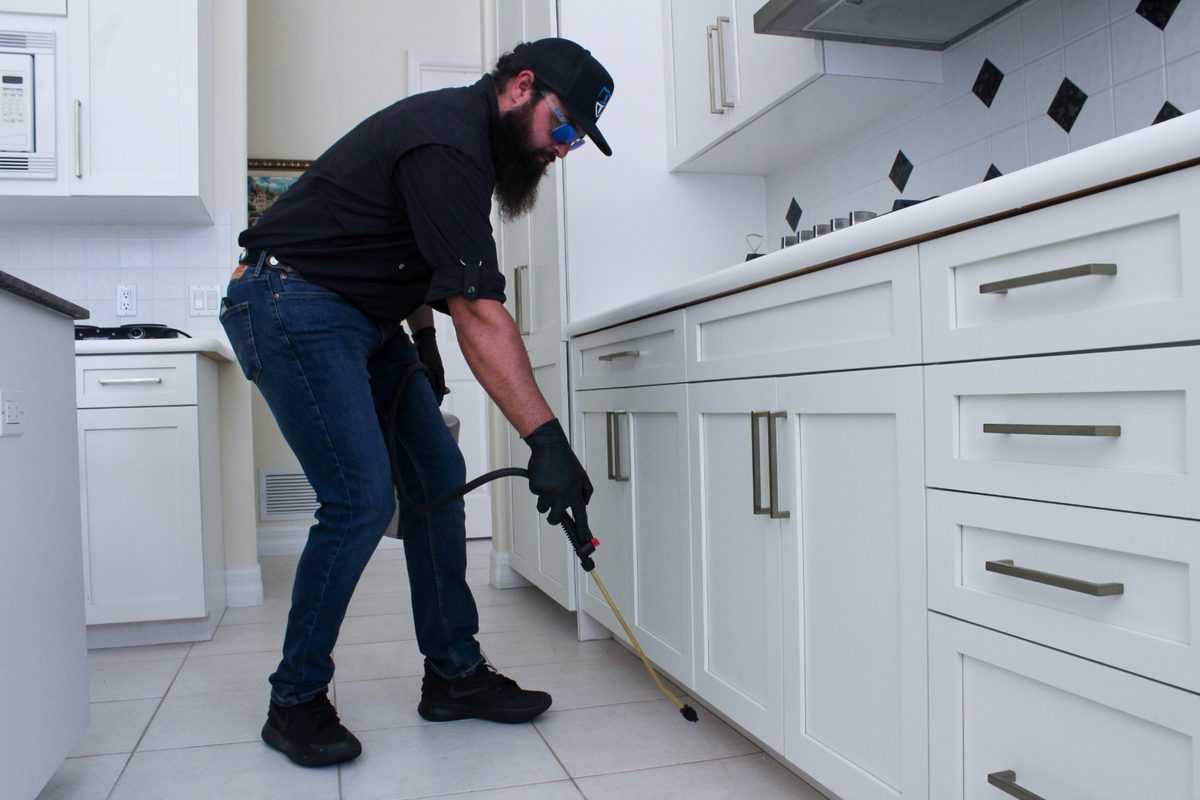
A termite swarm inside your Tampa home is alarming, but what you do in the next few minutes can determine how easy or difficult the subsequent inspection and treatment will be. There are right moves and wrong moves. Here they are in order.
Flying ants also swarm in spring and summer in Tampa, and the panic of finding dozens of winged bugs inside leads many homeowners to misidentify one for the other. This table gives you the exact anatomical traits to check — ideally with the sample you collected in step 2. When in doubt, call us: identifying the insect from a photo or sample is the first thing we do.
| Trait | Termite Swarmer | Flying Ant |
|---|---|---|
| Antennae | Straight, beaded (like a string of tiny pearls) | Elbowed — bent at a sharp angle like an elbow joint |
| Waist | Broad, no pinch — body is roughly the same width from thorax to abdomen | Pinched — distinct narrow waist between thorax and abdomen |
| Wings | Two pairs equal in length — all four wings are the same size | Two pairs unequal — front wings noticeably larger than rear wings |
| Wing Shedding | Yes — wings break off almost immediately after landing; you'll find wing piles on windowsills | No — wings stay attached to the ant's body |
| Body Color | Typically dark brown to black; wings clear to grayish; Formosans slightly lighter | Variable — black, red-black, or red depending on species |
| Size | Eastern subterranean: 1/4–3/8 inch; Formosan: 3/8–1/2 inch (larger) | Variable by species; carpenter ants 1/2–3/4 inch with swarmer forms similar in size |
| Wing Veins | Simple, few veins — wings look nearly translucent with minimal patterning | Complex venation — more distinct vein pattern in wings |
If you have a clear photo of the insect — especially the antennae and wing shape — text or email it to us and we can confirm the species before you even schedule an inspection. When flying termites in Tampa are involved, speed matters.
(813) 548-6341 Schedule Free InspectionSwarmers in your home mean a mature colony is within 300 feet — and swarmers emerging from inside your structure almost certainly mean the colony is already inside or directly adjacent to your home's framing. This is not a warning of a future problem. It is evidence of an active present one.
The timing of your swarm event is one of the strongest clues for species identification. Eastern subterranean, Formosan, and drywood termites all swarm at different times of year and under different conditions in the Tampa Bay area.
Reticulitermes flavipes is endemic throughout Hillsborough County and every Tampa neighborhood from South Tampa to New Tampa to Brandon. Swarms occur on warm, humid days following rainfall — typically mid-morning when soil temperature rises. Colony size: up to 300,000 workers. This is the species behind the vast majority of flying termites Tampa homeowners call about in spring. Look for daytime swarms near windows and light sources. Mud tubes on the foundation exterior, framing, or plumbing penetrations are the primary evidence to look for between swarm events.
Most commonly reported in TampaCoptotermes formosanus — the "supertermite" — arrived in Florida via Gulf ports and is actively expanding its range northward through the Tampa Bay corridor. Formosan swarms are nocturnal and occur in massive numbers around porch lights, streetlights, and illuminated windows. Colony size: up to 10 million workers. Feeding rate is 3–5× faster than Eastern subterranean. They can build "carton nests" — secondary above-ground colonies — inside walls or attic spaces that do not need soil contact. If you see swarmers around your lights on a warm May or June night in Wesley Chapel, New Tampa, or along the Hillsborough River corridor, treat this as a high-priority situation. Visit our termite control page for details on Formosan-specific treatment protocols.
Growing threat in Tampa Bay — treat urgentlyDrywood termites (Incisitermes snyderi and related species) live entirely within dry wood — no soil contact required. They enter through unprotected wood surfaces, attic vents, roof intersections, and any exposed wood on the exterior. Unlike subterranean species, they produce distinctive frass — dry, hexagonal, sand-like pellets pushed out through tiny kickout holes in the wood surface. No mud tubes. No soil activity. A smaller colony (a few thousand versus hundreds of thousands), but the lack of ground-contact makes them much harder to detect and treat with perimeter liquid treatments. Spot treatment or localized injection is the standard approach. They're especially common in older Tampa homes and in structures where wood trim or siding is in direct sun without regular protective coating.
No soil contact — frass is the tell-tale signThis is the most important thing to understand about termite swarmers: they do not come from young colonies. A termite colony must reach a certain maturity — typically 3 to 5 years old with thousands to hundreds of thousands of workers — before it produces swarmers at all. Swarmers are the colony's reproduction event, not its beginning.
When you see flying termites in your Tampa home, you are seeing evidence of an established, mature colony. The question is not "do I have termites?" — you do. The question is where they are and how long they've been there. That's what an inspection determines.
After a swarm, walk your property and look for these secondary evidence markers. Finding any one of them alongside your swarmer sighting significantly raises the probability of an active infestation — and tells your inspector exactly where to focus.
Eastern subterranean and Formosan termites build pencil-wide mud tubes — narrow tunnels made from soil, saliva, and feces — to travel from the ground to wood framing while maintaining humidity and avoiding light. Check the exterior foundation line, the garage stem wall, any concrete block, around plumbing entry points, and along piers or posts. Active tubes may have live termites inside when broken. Old tubes that crumble and don't get repaired indicate the colony may have moved on — but don't assume without an inspection. Mud tubes are the single most diagnostic sign of subterranean termite activity and one of the first things our technicians look for on every Tampa inspection.
Termite swarmers shed their wings almost immediately after landing — within seconds to minutes. Wing piles on interior windowsills, along baseboards near light sources, or at the bottom of sliding glass doors are one of the most commonly found post-swarm evidence items. The wings are translucent, roughly equal in size (both pairs), and about 1/4 to 3/8 inch long. Finding a significant accumulation of wings without any live swarmers means the swarm has already concluded — likely within the last 12 to 48 hours. Save the wings in a bag or tape them to a piece of paper and bring them when we arrive for the inspection. Flying termites in Tampa leave wing piles as their calling card.
Drywood termites kick their excrement out of the colony through small kickout holes in the wood surface. This frass is dry, hexagonal, and pellet-like — often described as fine sand or sawdust. You may find small piles of it on windowsills, on floors below baseboards, or on horizontal surfaces near wood trim. Unlike the sawdust from carpenter ants or wood decay, termite frass has a distinctive uniform pellet shape. This is not a sign of subterranean termite activity — subterranean termites incorporate their frass into their mud tubes. Finding frass elsewhere in Tampa, without mud tubes, points strongly toward drywood termites and requires a different treatment approach than liquid soil perimeter treatment.
Knock on floor joists, baseboards, door frames, window frames, and interior trim. Wood that has been hollowed out by termites feeding along the grain produces a characteristic papery, hollow sound when struck — very different from the solid knock of intact wood. Termites feed from the inside out, leaving a thin veneer of paint or wood surface intact for months or years before the damage becomes structurally visible or penetrates through. In Tampa homes, baseboards near bathrooms, kitchen cabinets against exterior walls, and wood framing near A/C condensation lines are especially common feeding sites due to the persistent moisture gradient that subterranean termites require.
When termites feed just beneath a painted surface, the moisture they introduce can cause the paint to darken, blister, or bubble — similar in appearance to water damage. Blistered paint on baseboards, door frames, or window casings in areas with no obvious plumbing or roof leak is a significant red flag in Tampa homes. The moisture that subterranean termites carry from the soil is enough to delaminate paint from wood over time, and the presence of this symptom in non-moisture-exposed locations almost always warrants a professional probe of the underlying wood. This evidence type is especially common in South Tampa and Tampa Heights older-construction homes where framing wood may be decades old and already compromised.
Doors or windows that suddenly stick, no longer close smoothly, or have shifted in their frames can be caused by moisture swelling in summer — but they can also indicate structural wood damage from termites. As framing lumber loses structural integrity from termite feeding, slight shifts in load distribution can cause door and window frames to distort. This is more likely to be termite-related when the sticking appears in an interior room that has no obvious moisture exposure, when it develops relatively quickly, and when it occurs alongside other evidence markers like hollow-sounding wood or mud tubes. In Tampa's slab-on-grade homes, sticking doors near the master bath or kitchen exterior wall deserve a closer look.
Florida as a whole has the highest termite pressure of any state in the continental United States — but Tampa Bay has a specific combination of factors that amplify that pressure beyond the Florida average. Understanding why helps explain why termite activity in Tampa is not an occasional event but a near-constant management challenge.
A termite call from a Tampa homeowner who just saw swarmers triggers a specific inspection and treatment sequence. Here's exactly what happens from first call to completed treatment.
Our technician arrives with a moisture meter, probe, and flashlight and performs a systematic inspection of the interior and exterior. We examine the foundation perimeter for mud tubes, probe baseboards and framing in common infestation areas (bathrooms, kitchens, utility rooms, garage walls), inspect the attic for any evidence of drywood activity, and check the crawl space or under-slab perimeter if accessible. Species identification using your collected sample or emergence point characteristics happens at this stage — everything downstream depends on knowing whether we're dealing with Eastern subterranean, Formosan, or drywood. This inspection is completely free for Tampa Bay homeowners.
Using the inspection findings, swarmer identification, mud tube mapping, moisture readings, and probing results, we assess the most likely colony location and determine whether the infestation is subterranean (soil-dependent), drywood (wood-internal), or a combination. For subterranean species, we identify the most probable entry points and map the perimeter to determine treatment linear footage. For drywood species, we identify the specific infested members and assess whether spot treatment or broader fumigation is warranted. This assessment drives the written treatment recommendation and quote.
We provide a written treatment recommendation that identifies the species confirmed, describes the treatment method selected, explains why that method is appropriate for your specific infestation type and construction, and provides a fixed price with no hidden charges. For subterranean infestations, we explain the choice between liquid soil treatment, bait systems, or a combination. For drywood infestations, we explain the spot treatment scope. You will never receive a pressure sales call after the inspection — the written quote is yours to review and decide on your timeline, though we do recommend acting within 2 to 4 weeks of the inspection.
Treatment method is matched to species and infestation characteristics. Eastern subterranean and Formosan infestations typically receive a Termidor-class liquid soil perimeter treatment — trenched and rodded along the foundation, applied under slabs at plumbing and conduit penetrations, and treating any wood-to-soil contact points. Bait systems (Sentricon-class) are installed in-ground at regular intervals around the perimeter when liquid treatment is not appropriate or when ongoing monitoring is a priority. Drywood infestations receive localized spot treatment with wood injection at confirmed infestation sites. We explain exactly what was applied, where, and what you should expect in the weeks that follow. Our termite control page describes each method in detail.
Termite treatment efficacy is not visible overnight. We schedule a follow-up visit 30 to 90 days after treatment to inspect for any new mud tube construction, new emergence points, or frass accumulation that would indicate ongoing activity. At this visit we confirm that treated areas show no new evidence, re-probe previously active areas, and assess whether any supplemental treatment is warranted. For liquid treatments, we also inspect at the perimeter for any gaps in treated soil that may require touch-up. You'll receive a written summary of the follow-up findings. If you have questions between the initial treatment and the follow-up visit, call us — that's what we're here for.
If you need an official WDO (Wood-Destroying Organism) inspection report for a real estate transaction, mortgage closing, or insurance documentation in the Tampa Bay area, our licensed WDO inspectors provide the FL-standard report format required by lenders. This is a separate service from a treatment inspection. See our WDO inspection page for report format, timing, and scheduling. We cover all of Tampa and the surrounding metro area.
We work across Tampa Bay every week — from South Tampa bungalows to New Tampa slab-construction homes to Wesley Chapel new builds. We know the construction types, the species pressures, and the soil conditions that make each neighborhood's termite risk profile different. This is local, expert service — not a national chain dispatching a franchise technician.
We don't charge for the inspection and we don't show up expecting to sell a treatment the same day. The inspection gives you information; you decide what to do with it. Our job is to give you an accurate picture of what's there, not to maximize per-visit revenue.
Most pest companies have a standard termite package they quote to every caller. We don't. The treatment we recommend is determined by the species identified in the inspection, the construction type, the infestation location, and the severity — because treating a drywood infestation with a subterranean protocol wastes your money and doesn't work.
We currently offer treatment-only services. No termite bond. No annual warranty program. We tell you this upfront — not after you've scheduled a treatment and asked about coverage. If a bonded warranty is important to you, we'll tell you that clearly so you can make an informed decision about your service provider.
Our technicians work in Brandon, Wesley Chapel, Riverview, Westchase, Carrollwood, Lutz, and across Tampa every week. We know that South Tampa's older homes have different construction vulnerability than slab-on-grade New Tampa builds, and that Formosan pressure is higher near the Hillsborough River than inland. Local knowledge makes inspections faster and more accurate.
Every question Tampa homeowners ask us after seeing termite swarmers — from flying termites vs. flying ants to treatment costs to insurance coverage.
Fill out the form and we'll reach out to schedule your free inspection. If you just saw swarmers today, call us directly — we prioritize same-day and next-day inspections for homeowners who have active swarm events. Serving all of the Tampa Bay area including Wesley Chapel, New Tampa, Brandon, Riverview, Westchase, Carrollwood, Lutz, Temple Terrace, South Tampa, St. Pete, and Clearwater.
We perform termite inspections and treatments across the entire Tampa Bay metro area — from South Tampa and Hyde Park to the I-75 corridor communities in Hillsborough, Pasco, and Pinellas counties.
Not on the list? We serve all of Hillsborough, Pasco, and Pinellas counties. Call (813) 548-6341 to confirm coverage in your neighborhood. See our Tampa pest control page for the full service area.